
Neurotransmitters
Key points
- Although a number of circuits with different neurotransmitters connect to and run through the ventral tegmentum, the main tracts use dopamine.
- Brain cells communicate messages via chemicals in the brain that are called neurotransmitters.
- Receptors and neurotransmitters function in a lock-and-key fashion.
- This is what allows messages to flow in tracts, which are laid out in a fashion similar to an electrical circuit within the brain.
Although a number of circuits with different neurotransmitters connect to and run through the ventral tegmentum, the main tracts use dopamine. Other important tracts use serotonin, norepinephrine, or endorphin. Let's look further at what neurotransmitters are and what they do.
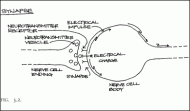
Brain cells communicate messages via chemicals in the brain that are called neurotransmitters. Neurotransmitters are compounds that are secreted at the end of a nerve cell when it is electrically stimulated by another cell attached to it. They are secreted into a tiny gap between the cells, which is called a synapse (fig. 3.2). As they dissolve into the fiuid within the synapse, some of these molecules become bound to receptors.
Receptors and neurotransmitters function in a lock-and-key fashion. The receptor is shaped precisely to fit the specific neurotransmitter it needs. Other chemicals will not bind at all, or might bind only loosely, producing a weaker signal.
Nerve cells generally produce only one kind of chemical.
This is what allows messages to flow in tracts, which are laid out in a fashion similar to an electrical circuit within the brain. One of the most common neurotransmitters involved in emotions and behaviors is called serotonin, or 5-hydroxytryptamine.
The suffix "ergic" is attached to the name of the specific neurotransmitter so as to identify which type of nerve cell it is. Nerve cells that produce serotonin are called serotoninergic and those that secrete dopamine are called dopaminergic neurons. The producers of norepinephrine (a substance similar to adrenaline) are called adrenergic, and the ones that produce peptides, such as endorphins and others, are called peptidergic.
What starts out sounding like a fairly simple pattern - nerve cells communicating with each other in a specific chemical chain - is actually complicated. It might help to think of the brain as resembling an ecosystem. Years ago we thought of clinical depression as involving a lack either of serotonin or of norepinephrine, which leads to a chemical imbalance - kind of like tipping a seesaw.
We know now that there are no fewer than fifteen different subtypes of serotonin receptors, some of which perform opposite functions, and the list is growing at the research labs. We also know that there are other chemicals involved in depression, perhaps farther "upstream" or "downstream," and that the nature of how these circuits work with one another can be influenced by other factors. So it's not a simple seesaw, after all.
Just as the loss of one species can change the environment of an entire forest or marsh, a change in the activity of just one neurotransmitter can have a cascade effect. As these tracts of nerve cells interact with each other, broad shifts occur within the chemical environment of the brain.
Written and revised by
David Cohen, M.D.
Our doctors write and review articles for accuracy and keep them up to date.
health.am provides general information, not medical advice. Always consult a qualified health professional about your own health.
Explore health topics
More in this topic
Mental Health → News
Parkinson's disease: A new tool aims to improve diagnosis and advance treatment
A group of experts working under the umbrella of the International Parkinson and Movement Disorder Society (MDS), have developed a new tool for healthcare professionals that they hope will mark a significant advancement…
15 November 2015
 News
Men with Alzheimer's gene at risk of brain bleeding, study finds
A common genetic variation, ApoE4, linked to Alzheimer's disease greatly raises the likelihood of tiny brain bleeds in some men, scientists have found. Such hemorrhages in brain tissue - microbleeds - leave small points…
12 November 2015
 News
Does alcohol consumption affect the risk for Parkinson's disease?
For many years, researchers have been investigating whether there are any associations between Parkinson's disease (PD) and lifestyle choices such as smoking and coffee and alcohol consumption. In a review published in…






