
Schizophrenia and Neurotransmitters
Key points
- When scientists study how the brains of people with mental illness are different, they are commonly interested in two issues: brain structure and function.
- Another area of interest to researchers is communication within the brain.
- Neurotransmitters are effectively the "messengers" of the brain, carrying information from one brain cell to another.
- Brain cells, called neurons, are responsive to different kinds of neurotransmitters and have receptors built specifically for them.
When scientists study how the brains of people with mental illness are different, they are commonly interested in two issues: brain structure and function. Researchers can study structure by comparing the brain anatomy in people with schizophrenia to brain anatomy in people without schizophrenia. Ventricle size is a good example of a structural anatomical difference seen in schizophrenia, whereas frontal lobe activity is a good example of a functional anatomical difference seen in schizophrenia.
Another area of interest to researchers is communication within the brain. Studying communication in the brain, a process carried out by substances called neurotransmitters, can help reveal even more about how the brains of people with schizophrenia differ from the brains of people without it. Studying neurotransmitters can reveal both structural and functional differences in the schizophrenic brain. Next, we will discuss how neurotransmitters work and how they appear to be implicated in schizophrenia symptoms.
Neurotransmitters. Neurotransmitters are effectively the "messengers" of the brain, carrying information from one brain cell to another.
Brain cells, called neurons, are responsive to different kinds of neurotransmitters and have receptors built specifically for them. Neurons that are sensitive to specific neurotransmitters tend to cluster together, creating circuits in the brain for processing specific kinds of information.
Neurotransmitters are released from a neuron when it signals another brain cell. The neurotransmitters are released into the small space between the two neurons, called the synapse. In the synapse, the neurotransmitters attach, or bind, to the receptors at the ends of another neuron, thus affecting the activity of the new neuron. The new neuron takes in as much of the neurotransmitter as it can and then releases the excess back into the synapse. The excess is reabsorbed by the first neuron, a process known as reuptake. Drugs that treat mood disorders like depression (e.g. Prozac, zoloft) regulate the amount of certain neurotransmitters available in the brain and the process of neurotransmitter reuptake, and affect communication between brain cells.
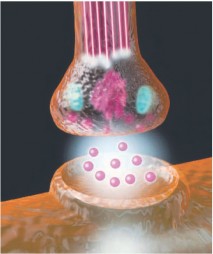
Figure 4.4 This computer graphic of a synapse shows the release of neurotransmitters (pink spheres at lower center) by vesicles inside the synaptic knob (upper center). The neurotransmitters will cross the gap and bond to the receptors of the adjacent cell, which is how information is transmitted along the nervous system. © Alfred Pasieka/Photo Researchers, Inc.
There are many different neurotransmitters in the brain. Two that have been found to be involved in schizophrenia symptoms are dopamine and glutamate. Dopamine is primarily involved in movement and thoughts. Dopamine has also been associated with novelty seeking, or interest in new experiences and reward. Some illegal drugs, such as cocaine and methamphetamine, work by affecting dopamine function in the brain. Thus, dopamine is associated with feelings of pleasure and well-being.
Written and revised by
Gerald Hurowitz, M.D.
Our doctors write and review articles for accuracy and keep them up to date.
health.am provides general information, not medical advice. Always consult a qualified health professional about your own health.
Explore health topics
More in this topic
Mental Health → News
Is The Pattern Of Brain Folding A “Fingerprint” For Schizophrenia?
Anyone who has seen pictures or models of the human brain is aware that the outside layer, or cortex, of the brain is folded in an intricate pattern of "hills", called gyri, and "valleys", called sulci. It turns out…
12 September 2014
 News
Happiness in schizophrenia 'is not an oxymoron'
It may be one of the most severe forms of mental illness, but a new study challenges the assumption that people with schizophrenia always enjoy life less than people in good physical and mental health. "People tend to…
25 August 2014
 News
International team sheds new light on biology underlying schizophrenia
As part of a multinational, collaborative effort, researchers from Canada's Centre for Addiction and Mental Health (CAMH) have helped identify over 100 locations in the human genome associated with the risk of…





