Geographical variation in incidence, course and outcome of schizophrenia
Key points
- Schizophrenia was not identified as a discrete illness until the dawn of the 20th century and was once widely considered a 'disease of civilization'.
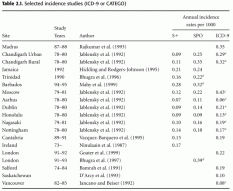
- CATEGO, computer algorithm diagnoses using Present State Exam; ICD, International Classification of Disease - ninth revision - Clinical Modification; S+, narrowly defined schizophrenia; SPO, broadly defined schizophrenia.
- In this section, we review the evidence for differences in incidence as well as course of schizophrenia between developing and developed countries.
- Incidence In a recent review of schizophrenia incidence studies, the annual incidence rates ranged from 0.04 to 0.58 per 1000 (Eaton, 1999).
Geographical variation in incidence, course and outcome of schizophrenia: a comparison of developing and developed countries
Schizophrenia was not identified as a discrete illness until the dawn of the 20th century and was once widely considered a 'disease of civilization'. Later evidence suggested that at least some cases of schizophrenia could be identified in any community at whatever level of development, but the incidence rate of schizophrenia in developing countries is still largely a matter for bold speculation based on minimal data. In the meantime, strong evidence has emerged for a surprising result: the course of schizophrenia is more benign in the developing countries, where treatment options are minimal.
In this section, we review the evidence for differences in incidence as well as course of schizophrenia between developing and developed countries. Present day researchers often prefer the more neutral designation of 'low-income' versus 'high-income' countries, which does not imply any universal continuum of economic development. For clarity, however, we retain the term used in the literature we review.
Incidence
In a recent review of schizophrenia incidence studies, the annual incidence rates ranged from 0.04 to 0.58 per 1000 (Eaton, 1999). Because the observed variation is likely to result in part from differences in the methods of individual studies (Bresnahan et al., 2000), its meaning with respect to geographic distribution is unclear. Systematic patterns of variation are obscured by these and other artifacts.
Here we have chosen to examine variation across sociocultural settings by comparing developing and developed countries. This approach is promising, in view of the high contrast between the sociocultural environments in these two settings. In addition, the division has been shown to have predictive value for studies of outcome.
Is the incidence of schizophrenia different in developing and developed countries? Our capacity to answer this question is constrained by the small number of studies conducted in developing countries. The total developing country evidence is slim and includes four published incidence studies (Jablensky et al., 1992; Hickling and Rodgers-Johnson, 1995; Bhugra et al., 1996; Mahy et al., 1999) based on first treatment contact and direct assessments in a defined population. The study locations include rural and urban Chandigarh, Trinidad, Barbados and Jamaica (Table 2.1). (One additional incidence study conducted in Madras (Rajkumar et al., 1993) ascertained cases based on a door-to-door community screening and direct assessment in a defined urban area. However, as the method was different from other studies, and the number of cases small, it has little bearing on the question at hand.)
{embed="ref/55"}
Among these four developing country studies reporting incidence, the Chandigarh study provides the most important evidence. It was part of the World Health Organization (WHO) Ten Country Study (Jablensky et al., 1992), in which both developed and developing country sites were included. In this landmark project, also referred to as the Determinants of Severe Mental Disorder Study (DOSMeD), the collection of comparable evidence in the same time period offers sound comparison of incidence rates across a variety of sociocultural settings.
Written and revised by
Gerald Hurowitz, M.D.
Our doctors write and review articles for accuracy and keep them up to date.
health.am provides general information, not medical advice. Always consult a qualified health professional about your own health.
Explore health topics
More in this topic
Mental Health → News
Telephone-Delivered Care for Treating Depression After CABG Surgery Appears to Improve Outcomes
Patients who received telephone-delivered collaborative care for treatment of depression after coronary artery bypass graft surgery reported greater improvement in measures of quality of life, physical functioning and…
18 November 2009
 News
Study shows that a combination of common genetic variations can lead to schizophrenia
A multi-national group of investigators, including a scientist at the University of North Carolina at Chapel Hill, has discovered that nearly a third of the genetic basis of schizophrenia may be attributed to the…
2 July 2009
 Guide
Depression in the Course of Schizophrenia
It is generally accepted that the first building block of modern psychiatric nosology was Kraepelin's distinction between those disorders we now know as mood disorders and the illness (or illnesses) we now know as…