Assessment of dependence and motivation to stop smoking
Key points
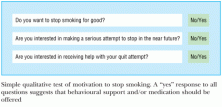
- Whether a smoker succeeds in stopping smoking depends on the balance between that individual's motivation to stop smoking and his or her degree of dependence on cigarettes.
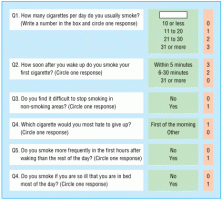
- Quantitative methods The most commonly used quantitative measure of dependence is the Fagerstrom test for nicotine dependence, which has proved successful in predicting the outcome of attempts to stop.
- Survey evidence in the United Kingdom shows that about two thirds of smokers declare that they want to stop smoking and that in any year almost a third make an attempt to stop.
- Clinicians must be able to assess both of these characteristics.
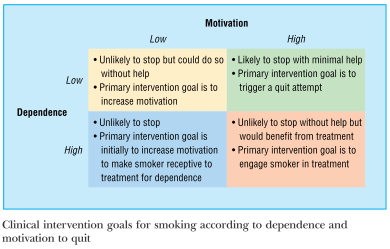
Whether a smoker succeeds in stopping smoking depends on the balance between that individual's motivation to stop smoking and his or her degree of dependence on cigarettes. Clinicians must be able to assess both of these characteristics. Motivation is important because "treatments" to assist with smoking cessation will not work in smokers who are not highly motivated. Dependence is especially important in smokers who do want to stop smoking, as it influences the choice of intervention. It is also important to bear in mind that:
* Motivation to stop and dependence are often related to each other: heavy smokers may show low motivation because they lack confidence in their ability to quit; lighter smokers may show low motivation because they believe they can stop in the future if they wish
* Motivation to stop can vary considerably with time and be strongly influenced by the immediate environment
* What smokers say about their wish to stop, especially in a clinical interview, may not accurately reflect their genuine feelings.
Measuring dependence in smokers
Qualitative methods
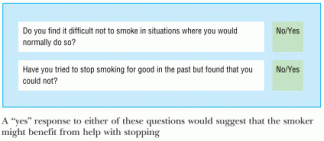
The simplest approach to measuring dependence on cigarettes is a basic qualitative approach that uses questions to find out whether the smoker has difficulty in refraining from smoking in circumstances when he or she would normally smoke or whether the smoker has made a serious attempt to stop in the past but failed.
Quantitative methods
The most commonly used quantitative measure of dependence is the Fagerstrom test for nicotine dependence, which has proved successful in predicting the outcome of attempts to stop. The higher the score on this questionnaire, the higher the level of dependence: smokers in the general population score an average of about 4 on this scale. Of all the items in the questionnaire, cigarettes per day and time to first cigarette of the day seem to be the most important indicators of dependence.
Objective methods
The concentration of nicotine or its metabolite, cotinine, in blood, urine, or saliva is often used in research as an objective index of dependence because it provides an accurate measure of the quantity of nicotine consumed, which is itself a marker of dependence. Carbon monoxide concentration of expired air is a measure of smoke intake over preceding hours; it is not as accurate an intake measure as nicotine based measures, but it is much less expensive and gives immediate feedback to the smoker.
How should dependence influence choice of treatment?The main value of measuring dependence in tailoring cessation interventions to individual smokers is in the choice of pharmacotherapy. The manufacturers of smoking cessation drug products (principally nicotine replacement therapy and bupropion—see later chapters in this series) recommend that only smokers of 10 or more cigarettes a day should use their products. However, the UK National Institute for Clinical Excellence has recently recognised this cut off to be arbitrary and has not specified any particular lower limit for daily cigarette consumption.
Written and revised by
Gerald Hurowitz, M.D.
Our doctors write and review articles for accuracy and keep them up to date.
health.am provides general information, not medical advice. Always consult a qualified health professional about your own health.
Explore health topics
More in this topic
Mental Health → News
Prosecutors warn pot smoking in public still outlawed in Washington state
With Washington state poised to become the first in the nation legalizing marijuana possession for adult recreational use, Seattle's city attorney issued a stern warning on Wednesday to those waiting to celebrate - no…
6 December 2012
 News
Smoking may worsen hangover after heavy drinking
People who like to smoke when they drink may be at greater risk of suffering a hangover the next morning, according to a study in the January 2013 issue of the Journal of Studies on Alcohol and Drugs. For anyone who has…
6 December 2012
 News
New approaches in the treatment of alcohol dependence
"Addiction is a brain disease" was the title of an editorial in the renowned journal "Science" 15 years ago. The author argued that recognising addiction as a disorder of the brain can impact society´s overall health…