Binge Drinking
Key points
- Binge drinking, which is generally defined as consuming five drinks on at least one occasion for men and four drinks on one occasion for women in the past 30 days, is primarily a problem among young adults and college students, although some adolescents also engage in binge drinking.
- Studies have shown that the attitude of their parents toward alcohol affects children.
- While a continuing barrage of newspaper articles, TV shows, and special interest group reports claim that binge drinking among young people is a growing epidemic, the actual fact is quite to the contrary.
- Binge drinking is a serious problem in the 21st century, responsible for many problems in society, such as individuals who drive while intoxicated, injuring themselves and others.
Binge drinking, which is generally defined as consuming five drinks on at least one occasion for men and four drinks on one occasion for women in the past 30 days, is primarily a problem among young adults and college students, although some adolescents also engage in binge drinking. Most binge drinkers consume beer; according to a study by Naimi et al. that was published in the American Journal of Preventive Medicine in 2007, 74.4 percent of binge drinkers drank only beer or mostly beer. Some people believe (clearly, an erroneous belief) that since beer has a significantly lower alcohol content than distilled spirits, that it is somehow safer. However, when beer is drunk to excess, it can often be a very dangerous substance.
Binge drinking is a serious problem in the 21st century, responsible for many problems in society, such as individuals who drive while intoxicated, injuring themselves and others. Aggressive behavior is much more common among those who binge drink, in the form of harm to sexual partners, children, and even casual acquaintances. Excessive drinking may cause some men to believe that they have an "excuse" to sexually assault women, because they have misread the cues women have sent and also because they may believe that intoxication is itself an excuse for aggressive and even criminal behavior.
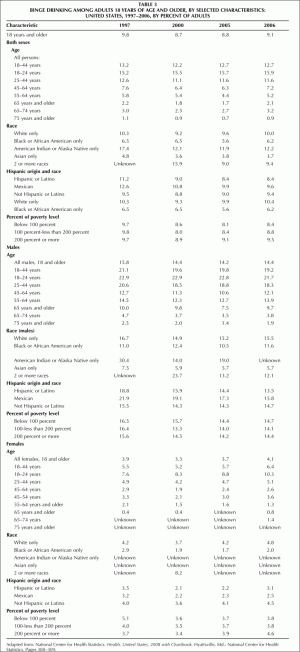
In 2006, an estimated 12.7 percent of individuals ages 18–44 engaged in binge drinking. The risk for binge drinking was highest among American Indians or Alaska Natives (12.2 percent) and lowest among Asians (3.7 percent). The risk for males was much higher (14.4 percent) than for females (4.1 percent). See Table 3 for further details.
As Table 3 shows, binge drinking has slightly decreased among many groups since 1997; for example, the rate of binge drinking among all persons 18–44 years of age in 1997 was 13.2 percent, and it dropped slightly to 12.7 percent by 2006; however, this newer rate is still problematic for many reasons. It is also interesting to note that binge drinking is less common among the poor; for example, 8.4 percent of men and women below 100 percent of the poverty level were binge drinkers in 2006, compared to 9.5 percent of those who earned 200 percent or more of the poverty level.
Parents and Children Who Drink at Home
Studies have shown that the attitude of their parents toward alcohol affects children. In addition, their parents' attitude toward underage drinking also affects children; if parents observe their own underage children drinking in the home and do nothing to stop them (and worse, sometimes even encourage this behavior), then adolescents and children receive the clear message that it is acceptable to drink, and they often will drink.
Table 3 -Binge Drinking Among Adults 18 years of age and older, by selected characteristics: United States, 1997-2006, by percent of adults
Written and revised by
Gerald Hurowitz, M.D.
Our doctors write and review articles for accuracy and keep them up to date.
health.am provides general information, not medical advice. Always consult a qualified health professional about your own health.
Explore health topics
More in this topic
Mental Health → News
How drinking too much sabotages your finances
In personal finance, the "latte effect" is shorthand for daily, frivolous expenditures that sneak up on you over time. If you just stop buying triple caramel lattes at Starbucks every afternoon, you can save "x" each…
4 November 2013
 News
When drinking and genes may collide
Many negative effects of drinking, such as transitioning into heavy alcohol use, often take place during adolescence and can contribute to long-term negative health outcomes as well as the development of alcohol use…
17 October 2013
 News
Friends, Family Often the Suppliers in Underage Drinking, Smoking: Survey
Many underage smokers and drinkers get their cigarettes and alcohol from family or friends, according to a Canadian study released Tuesday. Researchers at the Center for Addiction and Mental Health in Toronto surveyed…