Alcohol and Other Drugs: A Troublesome Combination
Key points
- Another major problem among many people who are dependent on alcohol is that they are also dependent on another drug.
- Many studies have shown that moderate drinking, or the consumption of no more than one to two drinks per day, may confer a health benefit, particularly in terms of preserving healthy cardiac function.
- Studies in Canada have shown that up to 30 percent of fatally injured drivers were using a combination of alcohol and drugs.
- The drug may be a stimulant, such as cocaine, or it could be a sedating drug such as benzodiazepine.
Another major problem among many people who are dependent on alcohol is that they are also dependent on another drug. The drug may be a stimulant, such as cocaine, or it could be a sedating drug such as benzodiazepine. (When used legally, benzodiazepines are antianxiety drugs.) The combination of illegal drugs or misused prescription drugs and alcohol is very dangerous and can be lethal.
Studies in Canada have shown that up to 30 percent of fatally injured drivers were using a combination of alcohol and drugs. A 2008 survey in Canada by Douglas J. Beirnes, published in 2009 by the Canadian Centre on Substance Abuse, found that 15.5 percent of drivers tested positive for alcohol, drugs, or both alcohol and drugs. The researchers found that alcohol use was most commonly found during weekends and late at night, while drug use was evenly distributed. Research in the United States and Canada has found that most drivers who abuse alcohol and drugs are males.
Moderate Drinking: A Health Boon to Some
Many studies have shown that moderate drinking, or the consumption of no more than one to two drinks per day, may confer a health benefit, particularly in terms of preserving healthy cardiac function. Other research shows that moderate drinking may be protective against the development of type 2 diabetes. Among people already diagnosed with diabetes, moderate drinking may provide a protective factor against heart disease as well; however, some studies show that moderate drinking may lead to hypoglycemia.
When health benefits are found with moderate drinking, these benefits are generally the most pronounced in middle-aged and older individuals, among whom moderate drinking may provide a protective benefit greater than abstinence offers.
However, if the moderate drinker escalates drinking to a higher level, the health benefits are lost.
Twenty-first Century Treatment Fortunately, enforced lobotomies and sterilizations and the other horrors of treatment for alcoholism are no longer lawful in the United States, and most people view them with horror. Today, hospitals, specialty clinics, and outpatient facilities treat individuals with alcohol dependence with medications such as naltrexone, acamprosate, and disulfiram, as well as with psychotherapy.
Table 3 -Binge Drinking Among Adults 18 years of age and older, by selected characteristics: United States, 1997-2006, by percent of adults
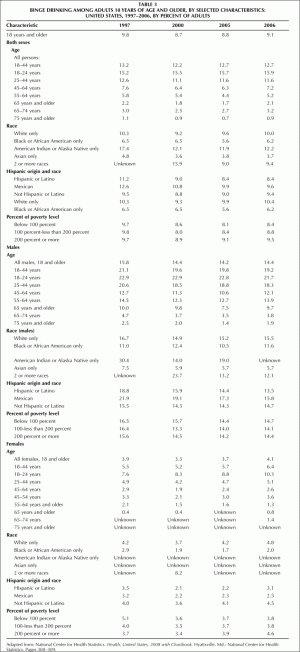
Adapted from: National Center for Health Statistics. Health, United States, 2008 with Chartbook. Hyattsville, Md.: National Center for Health Statistics. Pages 308–309.
Disulfiram, a drug used to induce aversion to alcohol, is still used today. This drug has an interesting history. It was first developed in 1947, when Danish researchers Erik Jacobsen and Jens Hald were testing it as a treatment to kill parasitic worms. They each tried the drug to see if it was toxic to them and did not notice any effects at all. However, later that day, the two researchers decided to go out and have a few drinks, and both quickly became extremely ill, with copious nausea and vomiting. After they recovered, Jacobsen and Hald realized that the drug might work far better as a treatment for alcoholism. (It is unknown if disulfiram works against parasites.)
Written and revised by
Andrey Nailor, M.D.
Our doctors write and review articles for accuracy and keep them up to date.
health.am provides general information, not medical advice. Always consult a qualified health professional about your own health.
Explore health topics
More in this topic
Mental Health → News
Research shows alcohol consumption influenced by genes
How people perceive and taste alcohol depends on genetic factors, and that influences whether they "like" and consume alcoholic beverages, according to researchers in Penn State's College of Agricultural Sciences. In…
25 September 2014
 News
Genetic Testing for Alcohol Dependence Risk in African Americans
Alcohol dependence (AD) has a genetic component and testing can determine a person's genetic risk for susceptibility to AD. A new study shows that while more than 85% of the African American adults expressed an interest…
16 July 2014
 News
Homeless Alcoholics Typically Began Drinking as Children
A phenomenological study offers detailed insights into homeless, alcohol-dependent patients often stigmatized by the public and policymakers as drains on the health care system, showing the constellation of reasons they…