
New Clinical Trial to Examine Ways to Improve Treatment of Uterine Fibroids
Key points
- Researchers at the University of Pennsylvania School of Medicine are working on ways to improve the results of a non-surgical method to treat fibroids.
- Uterine fibroids are benign (non-cancerous) tumors of the uterus that affect an estimated 20-40% of women, and for many, cause symptoms disrupting the quality of their lives.
- The treatment for uterine fibroids depends upon the size and location of the fibroids and the severity of symptoms.
- Interventional radiologists don't actually remove the fibroids during the UFE procedure.
Researchers at the University of Pennsylvania School of Medicine are working on ways to improve the results of a non-surgical method to treat fibroids. They are examining the overall effectiveness of different agents used to destroy uterine fibroids - a discovery that could lead to more answers about the durability of a procedure called Uterine Fibroid Embolization (UFE). It's already been established throughout the medical community that, after a decade, UFE works to relieve the symptoms of fibroids. Now, in this new study, investigators want to learn how to optimize the procedure, by running a comparison of materials used during it.
"We already know that UFE has an 85-90% success rate, offering less complications and a shorter recovery time than surgical options," Richard Shlansky-Goldberg, MD, Interventional Radiologist at Penn and Principal Investigator of this study, explains, "So in 2006, the question becomes, now that we know the procedure is effective and durable, 'Which product would be better?'"
Uterine fibroids are benign (non-cancerous) tumors of the uterus that affect an estimated 20-40% of women, and for many, cause symptoms disrupting the quality of their lives. Uterine Fibroids affect more than six million women in the U.S. each year. The exact reason uterine fibroids (the most common type of abnormal growth in the uterus) develop is unknown, but medical researchers have associated the condition with genetics and hormones. If left untreated, uterine fibroids can cause infertility.
The treatment for uterine fibroids depends upon the size and location of the fibroids and the severity of symptoms. Uterine fibroid embolization (UFE), also known as uterine artery embolization (UAE), is a minimally invasive alternative to a hysterectomy and is a proven way to treat fibroids and relieve its symptoms of heavy bleeding, pressure, pain, and excessive urination.
Interventional radiologists don't actually remove the fibroids during the UFE procedure. They shut them down and gradually shrink them, by blocking the blood supply to the fibroids. They do this by using a catheter to inject embolic agents (tiny plastic or sponge-like particles) into the artery, to "dam up" the blood flow to the fibroids.
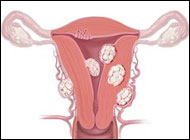
During this trial at Penn, several researchers will utilize two different embolic agents, comparing the outcomes in patients. 24 hours after each procedure, they will conduct an MRI to see how much fibroid tissue is destroyed. They'll look again, when the patient leaves the hospital. Shlansky-Goldberg adds, "We hope to answer two questions. One - In looking at the different outcomes of each particle, does one do a more effective job of eliminating fibroids? And two - What does the uterus look like immediately after the UFE procedure and then later, after three months?"
Written and revised by
Gerald Hurowitz, M.D.
Our doctors write and review articles for accuracy and keep them up to date.
health.am provides general information, not medical advice. Always consult a qualified health professional about your own health.
Explore health topics
More in this topic
Digestive Health → News
Researchers find two distinct genetic subtypes in Crohn's disease patients
Crohn's disease , a common inflammatory disorder of the intestinal tract, can have devastating consequences for a patient's quality of life and is notoriously hard to treat successfully, in part because its course and…
15 October 2016
NewsUNC researchers help create key diagnostic measures for gastrointestinal disorders
With no laboratory test available to diagnose functional gastrointestinal disorders , proper diagnostic criteria are critical for clinicians to make an accurate determination of what ails their patients. Several…
22 June 2016
NewsChanges needed to increase access to colorectal cancer screening
Colorectal cancer is the second highest cause of cancer death in the United States, expected to claim the lives of an estimated 49,190 people in 2016. The Affordable Care Act (ACA) aimed to increase access to CRC…