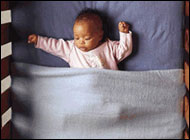
Swaddling effects could pose SIDS risk: study

Key points
- The calming effects of swaddling might make it more difficult for some infants to rouse from sleep - raising the possibility that the practice could increase the risk of sudden infant death syndrome (SIDS), a small study suggests.
- The study, reported in the Journal of Pediatrics, found that in 3-month-old infants new to swaddling, the practice seemed to reduce the brain response to an external stimulus - a puff of air delivered to the babies' nostrils.
- An infant's ability to rouse from sleep in response to such conditions is believed to play a role in SIDS.
- The potential role of swaddling in SIDS is controversial, with the few studies that have been done so far coming to conflicting conclusions.
The calming effects of swaddling might make it more difficult for some infants to rouse from sleep - raising the possibility that the practice could increase the risk of sudden infant death syndrome (SIDS), a small study suggests.
The study, reported in the Journal of Pediatrics, found that in 3-month-old infants new to swaddling, the practice seemed to reduce the brain response to an external stimulus - a puff of air delivered to the babies' nostrils.
An infant's ability to rouse from sleep in response to such conditions is believed to play a role in SIDS. The findings, therefore, raise the question of whether swaddling could, for infants new to the practice, increase the likelihood of SIDS, according to the researchers.
The potential role of swaddling in SIDS is controversial, with the few studies that have been done so far coming to conflicting conclusions.
On one hand, swaddling helps infants stay on their backs as they sleep, the recommended position for lowering SIDS risk. There are also some studies that show a lower prevalence of SIDS in cultural groups where swaddling is common.
However, some other studies have found that swaddled infants have no reduced SIDS risk, or even an increased risk. And one of the benefits ascribed to swaddling - sounder sleep - could be undesirable as far as SIDS risk; it's thought that problems arousing from sleep in response to breathing disruptions or other stimuli contribute to SIDS.
For the new study, Australian researchers studied the physiological effects of swaddling in 27 infants using polysomnography, which monitors heart rate, breathing, electrical activity in the brain and other functions as a person sleeps.
The infants were studied when they were 3 to 4 weeks old, and again at the age of 3 months. Fifteen had been regularly swaddled at home since birth or soon after, while 12 had not. The researchers monitored each infant's sleep when swaddled and when left unswaddled.
They found that among infants who were not normally swaddled at home, swaddling reduced brain arousal during sleep at the age of 3 months. The infants also showed less stability in their heart rate compared with when they slept unswaddled.
The same was not true of babies who had been routinely swaddled starting early in life, according to the researchers, led by Dr. Heidi L. Richardson of Monash University in Melbourne.
The findings suggest that decreased arousal during sleep may be less a result of swaddling, per se, and more an effect of an infant's unfamiliarity with sleeping swaddled, the researchers write.
However, the effect seen in new-to-swaddling infants at the age of 3 months is important, Richardson's team notes, because that is within the age range when SIDS risk is highest. They add that it is also the time point when many mothers return to work and leave their babies with a caregiver who may not be familiar with how the baby usually sleeps.
Written and revised by
Andrey Nailor, M.D.
Our doctors write and review articles for accuracy and keep them up to date.
health.am provides general information, not medical advice. Always consult a qualified health professional about your own health.
Explore health topics
More in this topic
Children's Health → News
Even an hour of TV a day ups risk of childhood obesity
Children who view television as little as an hour a day are significantly more likely to be overweight or obese and gain more unhealthy weight over time, according to a new study from the University of Virginia School…
30 April 2015
 News
A metabolic imbalance increases the risk of respiratory diseases in childhood
An imbalance in our metabolism can trigger inflammatory processes in the body and activate the immune system. In a recent study, published in the Journal of Allergy and Clinical Immunology, UFZ researchers have been…
27 March 2015
NewsPlant-based diet may reduce obese children's risk of heart disease
Obese children who begin a low-fat, plant-based vegan diet may lower their risk of heart disease through improvements in their weight, blood pressure, body mass index, cholesterol levels, insulin sensitivity, and…