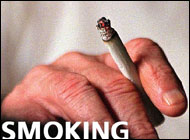
Smoking around kids exacts a high toll: studies

Key points
- American kids can breathe a sigh of relief, according to a study out today in the journal Pediatrics that finds their exposure to second-hand smoke at home has dropped significantly since the mid-1990s.
- But two other reports in the journal show that early-life exposure could lead to behavioral and health problems later in life.
- Exposure to second-hand smoke is known to cause lung problems, asthma, ear infections and contribute to sudden infant death syndrome (SIDS).
- In one of the three studies in the journal Pediatrics, Dr.
American kids can breathe a sigh of relief, according to a study out today in the journal Pediatrics that finds their exposure to second-hand smoke at home has dropped significantly since the mid-1990s.
But two other reports in the journal show that early-life exposure could lead to behavioral and health problems later in life.
Exposure to second-hand smoke is known to cause lung problems, asthma, ear infections and contribute to sudden infant death syndrome (SIDS). Smoking during pregnancy has also been linked to a host of psychological problems in children, such as attention deficit/hyperactivity disorder (ADHD) and antisocial behavior. But scientists have had a hard time teasing out the direct effects of tobacco versus lifestyle factors and mental health in the home.
In one of the three studies in the journal Pediatrics, Dr. Marie-Jo Brion of the University of Bristol, U.K., and colleagues tried to disentangle those factors by analyzing two long-term studies from Britain and Brazil.
Both studies had started in the early 1990s. Among British mothers, 16 percent reported smoking during pregnancy, compared with 29 percent in Brazil.
The researchers initially found that at age four, the kids whose mothers smoked had higher levels of hyperactivity, peer problems and bad behavior, such as bullying, cheating and lying. The kids didn't have more emotional problems, however.
After accounting for the parents' psychological health, economic position and whether the father smoked, only the bad behavior remained highly associated with having a mother who smoked, with odds increased up to 82 percent.
Brion said her results weren't bulletproof evidence that exposure to tobacco in the womb causes behavior problems directly, but that it was likely to do so.
Even if a prospective mother doesn't smoke, being around others who do could still affect her unborn child, according to the second study in Pediatrics.
Researchers from the University of Hong Kong studied 6,800 school-aged children whose mothers weren't smokers. If their dads smoked daily, however, they tended to weigh more compared to those kids who weren't exposed to second-hand smoke in the womb or after birth. On average, they packed on an extra pound or so.
The third study in Pediatrics shows that fewer kids are being exposed to smoke in the home. Dr. Gopal K. Singh of the U.S. Department of Health and Human Services in Rockville, Maryland, and colleagues report that overall, about 5.5 million American children, or 7.6 percent, were exposed to second-hand smoke in the home in 2007. By contrast, that number was 35 percent in 1994.
"That was a fairly dramatic drop," Singh said. "It is a positive message in the sense that exposure rates have declined." However, he and colleagues note that the 7.6 percent figure falls short of the 2010 revised national target for reducing childhood exposure to tobacco smoke at home, which is set at 6 percent.
Written and revised by
Andrey Nailor, M.D.
Our doctors write and review articles for accuracy and keep them up to date.
health.am provides general information, not medical advice. Always consult a qualified health professional about your own health.
Explore health topics
More in this topic
Children's Health → News
High sugar consumption among children relates to poor family functioning, study finds
The quality of general family functioning is a major determinant of healthy dietary habits - according to new research published in the Journal of Caries Research and led by Queen Mary University of London. The East…
23 August 2015
NewsPreemies at high risk of autism don't show typical signs of disorder in early infancy
Premature babies are at an increased risk for developing autism spectrum disorder. But a small study indicates that preemies who avoid eye contact in early infancy are less likely to demonstrate symptoms of autism at…
3 July 2015
 News
Kids and parents worry about schoolwork after concussions
Kids and teens who suffer a concussion worry about their academic skills in the weeks afterward, and older kids and those with more severe symptoms seems to worry the most, according to a new study. Studies in the last…