
Play therapy boosts HIV children
Key points
- Staff at a major African hospital are using play therapy to help mothers and their children to cope with HIV.
- To tackle the problem, therapists play with the children.
- "A lot of it was because they were also dealing with the possibility of this child moving on and dying in a couple of years.
- Occupational therapists at Groote Schuur Hospital in Cape Town, South Africa, discovered that many children with HIV had developmental problems.
Staff at a major African hospital are using play therapy to help mothers and their children to cope with HIV.
Occupational therapists at Groote Schuur Hospital in Cape Town, South Africa, discovered that many children with HIV had developmental problems.
While some of these difficulties could be attributed to the disease, staff believed that much of it was due to a lack of bonding between mother and child.
They found that mothers with HIV had distanced themselves from their offspring, almost in preparation for the child's death.
This meant that in many cases the children had never been taught or encouraged developmentally, for instance they could not crawl or sit.
Toy therapy
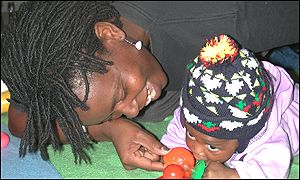
To tackle the problem, therapists play with the children. This, they say, shows mothers how to interact and develop a relationship with their children.
Elelwani Ramogondo, an occupational therapist at Groote Schuur Hospital, said the children's problems were often complex.
"Almost all of them would be developmentally delayed and more often than not it was gross motor development that was behind.
"So milestones like sitting, rolling even, sometimes even lifting their head up from the floor wouldn't happen at the time that it should."
Speaking on the BBC World Service programme Health Matters, she said: "Because with HIV having turned into Aids, a big thing that gets affected is endurance.
"It could be because of respiratory difficulties, not breathing sufficiently to give the circulation the oxygen that muscles need, illnesses like diarrhoea and a whole lot of things."
But she added: "The mothers don't know what to do to get the child to interact with their environment."
Ms Ramogondo said showing mothers how to interact with their children had proved helpful.
"They start watching me interacting with the child. It's almost like role modelling for them and the first thing is, you know, she's taking interest in her child in a different way."
Lack of bond
"The mothers don't know what to do to get the child to interact with their environment"
Elelwani Ramogondo
She said the lack of a bond was understandable.
"A lot of it was because they were also dealing with the possibility of this child moving on and dying in a couple of years.
"How do you begin to bond with someone that will leave you, almost certainly?"
She added: "And also the burden of guilt. Thinking you might probably have been the one that causes so much distress for your child. It really paralyses you."
Written and revised by
Gerald Hurowitz, M.D.
Our doctors write and review articles for accuracy and keep them up to date.
health.am provides general information, not medical advice. Always consult a qualified health professional about your own health.
Explore health topics
More in this topic
Children's Health → News
New study finds that orange sweet potato reduces diarrhea in children
A new study has found that orange sweet potato (OSP) reduced both the prevalence and duration of diarrhea in young children in Mozambique. The OSP was conventionally bred to provide more vitamin A in the diet. In…
16 June 2015
 News
National study finds rising rate of marijuana exposure among children 5 years old, younger
Debates about legalizing marijuana have focused on crime rates, economic benefits, and health effects among adults. But a study published today from researchers at Nationwide Children's Hospital shows that the risk to…
9 June 2015
 News
Is dietary supplementation appropriate for children with autism spectrum disorder?
Children with Autism Spectrum Disorder (ASD) are often picky eaters, which can lead parents to suspect that their children might not be getting adequate amounts of vitamins and minerals. This sometimes leads parents of…


