
Common Sleep Disorder Hinders School Performance
Key points
- A good night's sleep is critical to doing well in school because your child will be rested and can pay more attention in class and while doing homework.
- "One reason your child may not be getting a good night's sleep is that he or she is having breathing problems," said Robin A.
- "Pauses in breathing (sometimes called sleep apnea, but today referred to as 'sleep disordered breathing') cause a reduction of oxygen in the bloodstream," she said.
- "Over 90 percent of children who snore are at risk for sleep disordered breathing."
A good night's sleep is critical to doing well in school because your child will be rested and can pay more attention in class and while doing homework. While this is common sense, the reasons for not getting a good night's sleep can be complex; and the rewards for treatment can extend beyond better grades.
"One reason your child may not be getting a good night's sleep is that he or she is having breathing problems," said Robin A. Dyleski, MD director of Pediatric Otolaryngology at The New York Eye and Ear Infirmary. "The symptoms for breathing problems include: snoring, restlessness, gasping and pauses in breathing."
"Pauses in breathing (sometimes called sleep apnea, but today referred to as 'sleep disordered breathing') cause a reduction of oxygen in the bloodstream," she said.
"Over 90 percent of children who snore are at risk for sleep disordered breathing."
The most common cause of sleep disordered breathing in children, especially during deep sleep, is obstruction of the breathing passage by the presence of large tonsils and undetected adenoids, tonsil-like tissue behind the nose, according to Dr. Dyleski.
To find out if tonsils or adenoids are the cause of your child's breathing problems at night, it is best to check with your pediatrician, who may in turn refer you to a pediatric otolaryngologist, a specialist in ear, nose and throat disorders. Treatment may be as simple as treating a stuffy nose or as complex as a tonsillectomy and adenoidectomy.
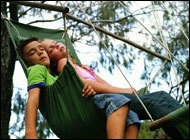
"If obstructive adenoids or tonsils are removed, and your child's sleep is improved, it may not only help with school work," said Dr. Dyleski, "Many children experience less asthma, less hyperactivity, improved attention span and colds seem to get better faster."
The New York Eye and Ear Infirmary, the oldest specialty hospital in the Western Hemisphere, is the primary teaching hospital for the New York Medical College. It has approximately 142,000 outpatient visits annually and over 20,000 surgical procedures per year. It has one of the nation's most extensive eye, ear, nose and throat clinics.
Source: Axel F. Bang PR & Marketing
Written and revised by
David Cohen, M.D.
Our doctors write and review articles for accuracy and keep them up to date.
health.am provides general information, not medical advice. Always consult a qualified health professional about your own health.
Explore health topics
More in this topic
Children's Health → News
Medical marijuana for children with developmental and behavioral disorders
As medical marijuana becomes increasingly accepted, there is growing interest in its use for children and adolescents with developmental and behavioral problems such as autism spectrum disorders (ASD) and…
7 February 2015
 News
Project pinpoints 12 new genetic causes of developmental disorders
The first results to emerge from a nationwide project to study the genetic causes of rare developmental disorders have revealed 12 causative genes that have never been identified before. The Deciphering Developmental…
27 December 2014
 News
Young children take but often barely touch healthy school cafeteria food options
You can offer young children healthier food choices in the elementary school cafeteria, but will they actually put it on their trays and eat it? Probably not, suggests a new Johns Hopkins Bloomberg School of Public…


