Theory and principles of cancer screening
Key points
- The practice of screening for cancer is based on the premise that early detection will have a positive effect on the outcome of the disease through medical intervention.
- The performance of a screening test is often defined by three related measurements: sensitivity, specificity, and positive predictive value.
- The disorder screened for should be an important cause of morbidity, disability, or mortality.
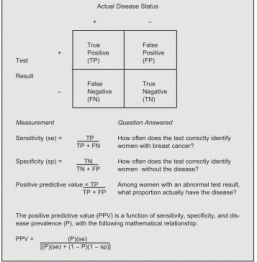
- The tests must have acceptable performance characteristics (for example, high levels of sensitivity and specificity, see Box 1-1 for definitions of screening test performance).
The practice of screening for cancer is based on the premise that early detection will have a positive effect on the outcome of the disease through medical intervention. The goal of screening is to reduce disease-specific morbidity and mortality through early treatment by identifying clinically occult (asymptomatic) tumors that are likely to become lethal. It is widely believed that early detection of such tumors will allow surgical removal of the cancer before the cells have begun to metastasize.
Policy decisions regarding the use of screening in large populations depends on data from clinical studies (R. Harris, 1999). In 1968, the World Health Organization proposed guidelines for clinical trials of tests used to screen for diseases (Wilson and Jungren, 1968):
1. The disorder screened for should be an important cause of morbidity, disability, or mortality.
2. The tests must have acceptable performance characteristics (for example, high levels of sensitivity and specificity, see Box 1-1 for definitions of screening test performance).
3. The tests must be available and acceptable to the target population and that population's physicians.
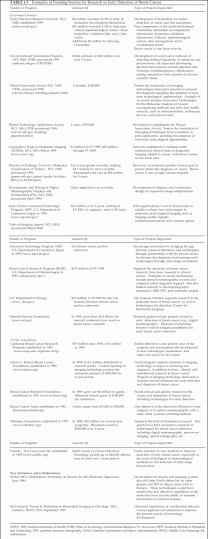
TABLE 1.1 Examples of Funding Sources for Research in Early Detection of Breast Cancer
NOTE: NIH, National Institutes of Health; OTIR, Office of Technology and Industrial Relations; FY, fiscal year; NIST, National Institute of Standards and Technology; PET, positron emission tomography; NASA, National Aeronautics and Space Administration; HCFA, Health Care Financing Administration.
4. Appropriate follow-up of individuals with positive findings must be ensured.
5. Screening should provide a net benefit to the target population, and the resources required to administer the tests under screening conditions must be justified in terms of the net benefits.
In other words, the natural history of the disease should be sufficiently well known, treatments should be sufficiently effective, risks resulting from screening should be acceptably low, and efficacy in reducing disease-specific morbidity and mortality should be high enough to conclude that early detection of the disease will be beneficial. Clearly, these standards are subject to value judgments in determining the relative importance of each condition and whether the conditions are adequately met. However, it is quite useful to refer to these recommendations when evaluating potential screening technologies.
{pagebreak}
BOX 1-1 Definitions of Screening Test Performance
Actual Disease Status
Written and revised by
Andrey Nailor, M.D.
Our doctors write and review articles for accuracy and keep them up to date.
health.am provides general information, not medical advice. Always consult a qualified health professional about your own health.
Explore health topics
More in this topic
Cancer → News
International molecular screening program for metastatic breast cancer AURORA at IMPAKT
While research has made great strides in recent decades to improve and significantly extend the lives of patients with early breast cancer, the needs of patients with advanced or metastatic disease have largely been…
7 May 2014
 News
Screening does not shift breast cancer to earlier stages
New research from Aarhus University suggests that screening for breast cancer results in increased diagnoses of early stage cancer -- but without a similarly sized decrease in the more serious and aggressive cases…
5 March 2014
 News
Mammography screening intervals may affect breast cancer prognosis
In a study of screening mammography-detected breast cancers, patients who had more frequent screening mammography had a significantly lower rate of lymph node positivity- or cancer cells in the lymph nodes - as compared…
4 December 2013