Normal Breast Development During Puberty
Key points
- Puberty in girls begins at the age of 10 to 12 years as a result of the influence of hypothalamic gonadotropin-releasing hormones secreted into the hypothalamic–pituitary portal venous system.
- The average breast measures 10 to 12 cm in diameter, and its average thickness centrally is 5 to 7 cm.
- During the first 1 to 2 years after menarche, hypothalamic-adenohypophyseal function is unbalanced, because the maturation of the primordial ovarian follicles does not result in ovulation or a luteal phase.
- These initial changes are induced by estrogens synthesized in immature ovarian follicles, which are anovulatory; subsequently, mature follicles ovulate, and the corpus luteum releases progesterone.
Puberty in girls begins at the age of 10 to 12 years as a result of the influence of hypothalamic gonadotropin-releasing hormones secreted into the hypothalamic–pituitary portal venous system. The basophilic cells of the anterior pituitary release follicle-stimulating hormone and luteinizing hormone. Follicle-stimulating hormone causes the primordial ovarian follicles to mature into graafian follicles, which secrete estrogens, primarily in the form of 17b-estradiol. These hormones induce the growth and maturation of the breasts and genital organs.
During the first 1 to 2 years after menarche, hypothalamic-adenohypophyseal function is unbalanced, because the maturation of the primordial ovarian follicles does not result in ovulation or a luteal phase. Therefore, ovarian estrogen synthesis predominates over luteal progesterone synthesis. The physiologic effect of estrogens on the maturing breast is to stimulate longitudinal ductal growth of ductal epithelium. Terminal ductules also form buds that precede further breast lobules. Simultaneously, periductal connective tissues increase in volume and elasticity, with enhanced vascularity and fat deposition.
These initial changes are induced by estrogens synthesized in immature ovarian follicles, which are anovulatory; subsequently, mature follicles ovulate, and the corpus luteum releases progesterone. The relative role of these hormones is not clear. In experimental studies, estrogens alone induce a pronounced ductular increase, whereas progesterone alone does not. The two hormones together produce full ductular-lobular-alveolar development of mammary tissues.
The marked individual variation in development of the breast makes it impossible to categorize histologic changes on the basis of age. Breast development by age has been described by external morphologic changes.
Morphology
Adult Breast
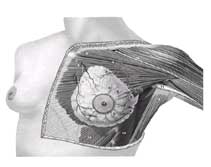
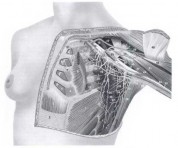
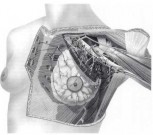
The adult breast lies between the second and sixth ribs in the vertical axis and between the sternal edge and the midaxillary line in the horizontal axis (Fig. 1-1). The average breast measures 10 to 12 cm in diameter, and its average thickness centrally is 5 to 7 cm. Breast tissue also projects into the axilla as the axillary tail of Spence. The contour of the breast varies but is usually domelike, with a conical configuration in the nulliparous woman and a pendulous contour in the parous woman. The breast comprises three major structures: skin, subcutaneous tissue, and breast tissue, with the last comprising both parenchyma and stroma. The parenchyma is divided into 15 to 20 segments that converge at the nipple in a radial arrangement. The collecting ducts that drain each segment are 2 mm in diameter, with subareolar lactiferous sinuses of 5 to 8 mm in diameter. Between five and ten major collecting milk ducts open at the nipple.
Written and revised by
Andrey Nailor, M.D.
Our doctors write and review articles for accuracy and keep them up to date.
health.am provides general information, not medical advice. Always consult a qualified health professional about your own health.
Explore health topics
More in this topic
Cancer → News
Study may help reassure women taking tamoxifen for breast cancer
A study led by Loyola Medicine researchers may help reassure patients who worry the breast cancer drug tamoxifen could increase their risk of uterine cancer. The multi-center study was presented during the 2016 annual…
7 June 2016
 News
High fruit intake during adolescence linked with lower breast cancer risk
Two linked papers in The BMJ this week shed new light on the relation of alcohol and diet with breast cancer and heart disease . The first study reports that high fruit consumption during adolescence may be associated…
13 May 2016
 News
Andrei Goga's UCSF team finds new approaches to eradicate aggressive breast cancers
Conventional chemotherapy generally fails to eradicate aggressive breast cancers due to the early distant metastasis that can occur in these diseases. Triple-negative breast cancer (TNBC) is a particularly aggressive…