
Primary Chemotherapy - Head and neck cancer
Key points
- Although chemo-therapy has not improved the short-term survival of patients with recurrent or metastatic HNSCC, promising results are emerging from the intense study of chemotherapy as an adjunct to standard primary treatment (surgery and/or radiotherapy) of advanced local disease.
- Chemotherapy can play a role in the primary treatment of more than 60% of all HNSCC patients or those who are diagnosed with advanced or extensive (T3-4N2-3M0) locoregional disease.
- Severe morbidities after surgery, high mortality rates, and the poor outcome of chemotherapy for recurrent tumors led to clinical investigations of many therapeutic variations of primary chemotherapy.
- Many reports have used the terminology of primary chemotherapy loosely.
Although chemo-therapy has not improved the short-term survival of patients with recurrent or metastatic HNSCC, promising results are emerging from the intense study of chemotherapy as an adjunct to standard primary treatment (surgery and/or radiotherapy) of advanced local disease. A patient's prognosis and treatment depend on the primary tumor site and TNM stage. Early-stage (T1-2N0M0) disease is usually cured through standard local treatment. After cure, early-stage patients have a high risk of second primary tumors. Therefore, it is critically important to develop effective chemopreventive agents in this setting. Patients with definitively treated primary cancers of the head and neck or lung should be strongly encouraged to participate in clinical chemoprevention trials because of their high risk of second primary tumors.
Chemotherapy can play a role in the primary treatment of more than 60% of all HNSCC patients or those who are diagnosed with advanced or extensive (T3-4N2-3M0) locoregional disease. This is so because advanced HNSCC is both a locoregional and a systemic phenomenon. Although optimal surgery or radiotherapy has improved local or regional control, neither treatment has improved survival. Two years after standard treatment, clinical evaluations indicate that less than 40% of these patients will be disease-free; local invasion and regional lymph node metastases are diagnosed in 60%, and distant metastases are found in 15% to 25%. The rate of distant metastases is actually far greater. Autopsy series show that occult distant metastases are present in up to 50% of HNSCC fatalities.
Severe morbidities after surgery, high mortality rates, and the poor outcome of chemotherapy for recurrent tumors led to clinical investigations of many therapeutic variations of primary chemotherapy. These approaches fall into three main categories: (1) neoadjuvant (induction) chemotherapy (before standard surgery and/or radiotherapy), (2) adjuvant chemotherapy (following definitive standard primary therapy), and (3) concomitant chemotherapy (in combination with radiotherapy, usually in patients with unresectable HNSCC). The principal goals of primary chemotherapy in HNSCC patients are to enhance locoregional control (relapse prevention, organ preservation, and primary curative treatment), decrease distant metastases, and improve overall survival.
Many reports have used the terminology of primary chemotherapy loosely. Some authors refer to "adjuvant chemotherapy" as any and all primary chemotherapy. They intend this phrase merely to distinguish primary chemotherapy from the treatment of recurrent disease. However, we distinguish among neoadjuvant, adjuvant, and concomitant chemotherapy. We use the term "adjuvant chemotherapy" only to refer to prevention of relapse after standard therapy. Neoadjuvant chemotherapy refers specifically to tumor reduction prior to definitive therapy, and concomitant chemotherapy refers to chemotherapy given concomitantly with radiotherapy intended to achieve definitive control of local, regional, and micrometastatic disease.
Written and revised by
Gerald Hurowitz, M.D.
Our doctors write and review articles for accuracy and keep them up to date.
health.am provides general information, not medical advice. Always consult a qualified health professional about your own health.
Explore health topics
More in this topic
Cancer → News
New way to identify patients at risk of dysphagia after head and neck cancer treatment
At the 3rd International Conference on innovative approaches in Head and Neck Oncology (ICHNO), Dr Hanna Rahbek Mortensen and colleagues at hospitals and institutes in Denmark presented results from a large prospective…
1 March 2011
 Overview
Head and Neck Cancer
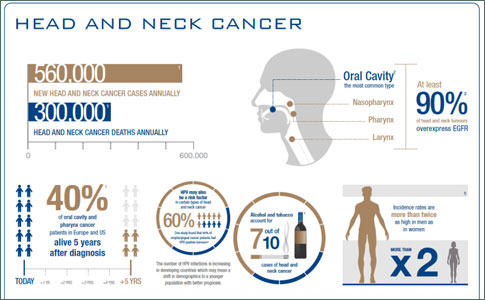
While head and neck cancer accounts for only 3% of all new cancer cases and 2% of all cancer deaths in the United States annually, it is the fifth most common malignancy worldwide.
28 February 2011
 News
Gene expression to distinguish metastasizing from non-metastasizing head and neck cancers
The validation of a test, based on gene expression and predicting the tumours that will metastasize in lymph nodes of head & neck cancers, was presented today at the 3rd International Conference on innovative approaches…


