
Chemotherapy - Head and neck cancer

Key points
- Overview The role of chemotherapy in the primary treatment of locally advanced head and neck cancer has become established in certain clinical settings.
- Research into breast, lung, prostate, and colon cancers benefits from large, relatively homogeneous study groups.
- Prognostic Factors Prognostic factors for chemotherapy response generally accepted as standard include performance status, nutritional status, degree of tumor differentiation, tumor burden (size of primary tumor, resectability, and extent of regional nodal metastases), disease stage, and primary cancer site.
- Chemotherapy Response Comparing the results of HNSCC chemotherapy trials can be difficult because of inconsistent standards for response determination.
Overview
The role of chemotherapy in the primary treatment of locally advanced head and neck cancer has become established in certain clinical settings. These include the definitive treatment of nasopharyngeal carcinoma and in organ preservation protocols for laryngeal and hypopharyngeal tumors. It also plays a role in the palliation of recurrent disease.
Research into breast, lung, prostate, and colon cancers benefits from large, relatively homogeneous study groups. HNSCC research, on the other hand, suffers from great disease heterogeneity and a relatively low incidence in the United States, factors contributing to confusion and conflicting reports regarding chemotherapy outcome (response and survival) and underscoring the importance of large multicenter randomized chemotherapy trials. Large-scale studies of laryngeal and nasopharyngeal cancers are demonstrating the importance of multicenter studies of specific HNSCC sites.
Prognostic Factors
Prognostic factors for chemotherapy response generally accepted as standard include performance status, nutritional status, degree of tumor differentiation, tumor burden (size of primary tumor, resectability, and extent of regional nodal metastases), disease stage, and primary cancer site. In head and neck cancer, however, correlative results are conflicting, and it is difficult in most cases to say which of these standard factors has significant effects on response. One clear exception relates to site; undifferentiated nasopharyngeal cancer is the most responsive and adenoid cystic salivary gland cancer the least responsive to chemotherapy. Recent work looking for additional prognostic factors in HNSCC has focused on immunologic studies, tumor DNA content, p53, thymidylate synthase, glutathione S-transferase, and GADD 153.
Chemotherapy Response
Comparing the results of HNSCC chemotherapy trials can be difficult because of inconsistent standards for response determination. Confusion regarding tumor measurements can arise as a result of superinfection from ulcerative lesions or, in studies in recurrent disease, from scarring after local therapy. The timing of response determination also varies. Clinical response determinations 4 to 6 weeks after therapy often describe persistent nonmalignant abnormalities (eg, fibrosis, edema) that resolve after longer follow-up. This is a problem with bulky tumors treated with chemoradiotherapy.
Complete response to chemotherapy is of overwhelming importance to a patient's survival outlook. Response reporting in primary HNSCC trials differentiate between responses at primary sites and those at regional sites. Pathologic documentation of primary-site clinical complete response is critical, and the number and depth of biopsies must be rigorously defined. There is disagreement, however, as to the comparative importance of histologic and clinical complete responses. Much of the discrepancy in this area of research may relate to a lack of thoroughness in clinical staging and a lack of uniform specifications for the number and depth of postchemotherapy biopsies. Although critical in screening for new drug activity, partial responses generally do not increase survival in primary or recurrent disease.
Written and revised by
Andrey Nailor, M.D.
Our doctors write and review articles for accuracy and keep them up to date.
health.am provides general information, not medical advice. Always consult a qualified health professional about your own health.
Explore health topics
More in this topic
Cancer → News
New way to identify patients at risk of dysphagia after head and neck cancer treatment
At the 3rd International Conference on innovative approaches in Head and Neck Oncology (ICHNO), Dr Hanna Rahbek Mortensen and colleagues at hospitals and institutes in Denmark presented results from a large prospective…
1 March 2011
 Overview
Head and Neck Cancer
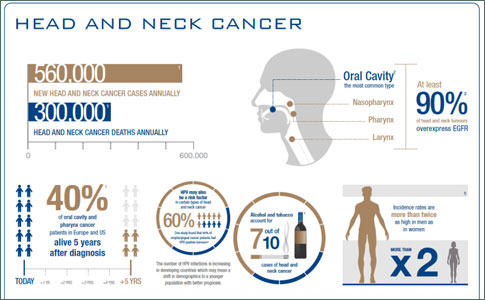
While head and neck cancer accounts for only 3% of all new cancer cases and 2% of all cancer deaths in the United States annually, it is the fifth most common malignancy worldwide.
28 February 2011
 News
Gene expression to distinguish metastasizing from non-metastasizing head and neck cancers
The validation of a test, based on gene expression and predicting the tumours that will metastasize in lymph nodes of head & neck cancers, was presented today at the 3rd International Conference on innovative approaches…


