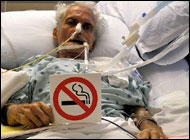
Cancer killing younger people in India, tobacco main cause

Key points
- Cancer is killing younger people in India and affecting far more poor and less-educated villagers than wealthier, better-educated urban people, researchers reported on Wednesday.
- - Tobacco has been used in India for centuries. - Early forms of tobacco were limited to chewing tobacco leaves or smoking tobacco.
- Thirty per cent of the population 15 years or older - 47% men and 14% of women - either smoked or chewed tobacco, which translates to almost 195 million people - 154 million men and 41 million women in India.
- "Cancer appears earlier (in India) than say in China or the U.S., so it's a disease of the young," said the lead author of the paper, Professor Prahbat Jha at the Centre for Global Health Research at the University of Toronto in Canada.
Cancer is killing younger people in India and affecting far more poor and less-educated villagers than wealthier, better-educated urban people, researchers reported on Wednesday.
"Cancer appears earlier (in India) than say in China or the U.S., so it's a disease of the young," said the lead author of the paper, Professor Prahbat Jha at the Centre for Global Health Research at the University of Toronto in Canada.
Jha said this could be because of India's younger population and the long-standing use of tobacco, which is the main cause of cancer in the country and responsible for 40 percent of cancers in men and 20 percent in women.
In men, the top three cancer killers were oral, stomach and lung cancer, while in women, they were cervical, stomach and breast cancer.
"The males have been smoking for a very long time, even longer than the Chinese and the patterns of diseases that come from prolonged smoking can occur in a population even at a younger ages," Jha told Reuters in a telephone interview.
According to The Tobacco Atlas, 26.2 percent of males in India use tobacco, either smoking or chewing it, or both. For females, 3.6 percent use tobacco and most of them chew it.
Chewing tobacco has long been linked to oral cancer, and this study found that the number of oral cancers was twice that of lung cancer in India.
Tobacco use in India: An evil with many faces
- Tobacco has been used in India for centuries.
- Early forms of tobacco were limited to chewing tobacco leaves or smoking tobacco. Today, several products made of, or containing tobacco, are available in the market.
- More than 4,000 diferent chemicals have been found in tobacco and tobacco smoke. More than 60 of these chemicals are known to cause cancer (carcinogens).
- Nicotine is a drug found in tobacco. It is highly addictive – as addictive as heroin or cocaine. Over time, a person becomes physically and emotionally addicted to, or dependent on, nicotine.
- Almost 30 percent of the Indian population older than age 15 uses some form of tobacco. Men use more smoked tobacco than smokeless tobacco.
Women are more likely to use smokeless (chewed) tobacco. Beedis are smoked more than cigarettes.
Jha said the most important message from the study, which was published in The Lancet, is for India's government to increase tobacco taxes and prices substantially - which studies have shown to be the single most effective measure to reduce smoking.
Tobacco use in India
Thirty per cent of the population 15 years or older - 47% men and 14% of women - either smoked or chewed tobacco, which translates to almost 195 million people - 154 million men and 41 million women in India. However, the prevalence may be underestimated by almost 11% and 1.5% for chewing tobacco among men and women, respectively, and by 5% and 0.5% for smoking among men and women, respectively, because of use of household informants. Tobacco consumption was significantly higher in poor, less educated, scheduled castes and scheduled tribe populations. The prevalence of tobacco consumption increased up to the age of 50 years and then levelled or declined. The prevalence of smoking and chewing also varied widely between different states and had a strong association with individual's sociocultural characteristics.
Written and revised by
Andrey Nailor, M.D.
Our doctors write and review articles for accuracy and keep them up to date.
health.am provides general information, not medical advice. Always consult a qualified health professional about your own health.
Explore health topics
More in this topic
Addiction → News
Rheumatoid Arthritis Drug Linked to Serious Infections and Cancers
A new meta-analysis of many previous studies of TNF- (tumor necrosis factor) blocking antibodies for treatment of rheumatoid arthritis has confirmed a previously discovered increased risk for serious infection and has…
18 May 2006
NewsSmoking causes far more cancer deaths in Asian-Americans than previously thought
Korean, Chinese, Japanese, and Vietnamese American males living in California die of cancer at three times the rate of South Asian females in California, whose cancer mortality rate is one of the lowest in the world.…
19 April 2006
 News
Older people are far more likely to successfully quit smoking
Older women appear to quit smoking and stay off cigarettes in higher numbers than men in their age group, and older men and women are more likely to quit if they have recently received a diagnosis of cancer, according…