Infectious Diseases (Except Sexually Transmitted Diseases)
Key points
- Vulvo-Vaginitis The prepubertal vulva is thin, delicate, and susceptible to trauma, infection and irritation as it lacks labial fat pads and pubic hair.
- The unestrogenized vaginal mucosa is thin and atrophic, has a neutral pH, and is an excellent medium for bacterial growth.
- Vulvitis without vaginal involvement is very common in young girls.
- Symptoms include pruritus and urinary and/or anal signs.
Vulvo-Vaginitis
The prepubertal vulva is thin, delicate, and susceptible to trauma, infection and irritation as it lacks labial fat pads and pubic hair. The anus is anatomically closer to the introitus, allowing contamination with feces and fecal pathogens.
The unestrogenized vaginal mucosa is thin and atrophic, has a neutral pH, and is an excellent medium for bacterial growth. In addition, hygiene in prepubertal children is frequently substandard as maternal supervision diminishes with age. The distinction (by history and clinical examination) between vulvitis and vaginitis has to be made. In vulvitis, dermatologic lesions involve exclusively the vulva and there is no vaginal discharge; often symptomatic treatment and advice will be enough. In cases of vaginitis, there are both clinical vulvo-vaginal manifestations and a vaginal discharge and a sexually transmitted disease has to be excluded.
Vulvitis without vaginal involvement is very common in young girls.
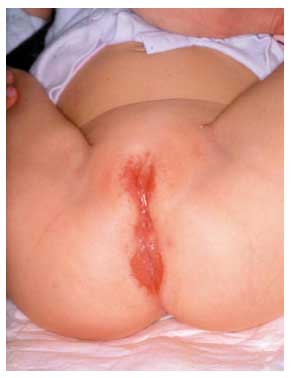
Symptoms include pruritus and urinary and/or anal signs. Clinical examination often shows an isolated erythema, without other dermatologic lesions. In these cases, there is no need for bacteriologic swabs as they are related to poor hygiene, irritants, and sometimes pinworms. Recommendations for improved hygiene and avoidance of irritation, in association with treatment of pinworms, are sufficient measures.
Vulvo-vaginitis with a discharge is most likely due to an infection or a retained foreign body. In this case, it is very important to clarify whether there is sexual contamination (sexually active teenagers or children who are being abused): a pertinent history and a clinical examination have to be very carefully conducted.
Any discharge must be fully investigated and samples taken for wet smears to screen for Trichomonas and Candida as well as for Gram staining and bacterial cultures. In prepubertal girls, pathogenic organisms include Streptococcus pyogenes (group A hemolytic streptococci), Haemophilus influenzae, Streptococcus pneumoniae, Staphylococcus aureus, Neisseria meningitidis, Shigella, Yersinia. Candida vulvo-vaginitis may occur in post-pubertal girls but is very rare in early infancy. Sexually transmitted disorders of bacterial origin include Trichomonas, gonorrhea and Chlamydia infections. In case of persistent vulvo-vaginitis with negative bacterial cultures, a vaginoscopic examination should be performed under anesthesia to rule out a retained foreign body.
Perineal Dermatitis
Bullous impetigo is characterized by the formation of large flaccid bullae arising from normal skin. The bullae rupture leaving red denuded round areas with honey-colored crusts. Those lesions spread rapidly and can quickly involve the thighs, buttocks, and abdomen. The causative agent is often S. aureus phage type II, which produces an epidermolytic toxin. Treatment is topical and general antibiotherapy.
Written and revised by
David Cohen, M.D.
Our doctors write and review articles for accuracy and keep them up to date.
health.am provides general information, not medical advice. Always consult a qualified health professional about your own health.
Explore health topics
More in this topic
Women's Health → News
Hysterectomy can be safely combined with cosmetic surgery for 'hanging abdomen'
For women undergoing hysterectomy, removal of "hanging" abdominal fat and skin--a cosmetic procedure called panniculectomy - can be performed at the same surgery without increasing the risk of complications, reports a…
3 September 2015
 News
Women undergoing fertility treatment can succeed with fewer hormones
Since the early days of fertility treatment, women undergoing IVF treatment have had to place a hormonal gel in their vagina on a daily basis for at least 14 days after embryo transfer. The hormone is necessary to…
26 August 2015
 News
Data mining DNA for polycystic ovary syndrome genes
Polycystic ovary syndrome (PCOS) has been passed down in many families for generations - causing reproductive and metabolic health problems for millions of women around the world. Yet, its cause remains unknown despite…