
Aid scheme tackles African witch myth
Key points
- Aid workers in Tanzania are trying to dispel the myth that old women are witches as part of efforts to improve their health.
- The scheme, funded by Comic Relief and the Department for International Development, also aims to improve older women's quality of life by improving their housing and agricultural practices to help them make money.
- The programme is also hoping to boost the health of older women by improving eating habits and making them aware of medical services.
- In many African villages, old women living on their own or in isolation are often accused of being witches with local people holding them responsible for tragic events or even general hardship.
Aid workers in Tanzania are trying to dispel the myth that old women are witches as part of efforts to improve their health.
In many African villages, old women living on their own or in isolation are often accused of being witches with local people holding them responsible for tragic events or even general hardship.
The women are victimised and intimidated and in many cases they are killed.
But a UK-sponsored programme is educating people in one area of Tanzania to end the practise.
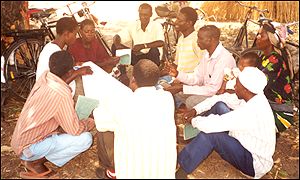
HelpAge International, a global network of not-for profit organisations, has started schemes in 70 villages in Sukumaland in the north-west of the country.
Sixbert Mbaya, who manages one of the programmes in Magu, said: "We use traditional drama groups, dances, choirs to pass educational messages to the entire community that older people are not witches."
Quality of life
The scheme, funded by Comic Relief and the Department for International Development, also aims to improve older women's quality of life by improving their housing and agricultural practices to help them make money.
One villager, 80-year-old Elizabeth Kulola, who is taking part in the programme, said life in Magu was difficult.
"Life is difficult in the village because health services are very distant and in most cases drugs aren't available.
"We have no sources of income, we don't have enough money to buy cloth, we have poor shelter, those things are making life difficult in the villages."
The efforts of aid workers are making a difference.
Before the programme began, they discovered many older women were being called witches because they had red eyes.
This was due to the fact that they were cooking with low quality fuel in smoky areas.
Under the scheme, their kitchens have been transformed so that smoke is now emitted outside - reducing red eyes and hopefully allegations of witchcraft.
Boost health
The programme is also hoping to boost the health of older women by improving eating habits and making them aware of medical services.
"We kind of tried to establish a strategy where we'll see that older people access medical services more and more," said Mr Sixberth.
"Life is difficult in the village because health services are very distant and in most cases drugs aren't available"
Elizabeth Kulola
"The government had put in place a circular stating that older people will get free medical services but the problem was the older people didn't know what they were entitled to."
Written and revised by
David Cohen, M.D.
Our doctors write and review articles for accuracy and keep them up to date.
health.am provides general information, not medical advice. Always consult a qualified health professional about your own health.
Explore health topics
More in this topic
Women's Health → News
Study examines cesarean section delivery and autism spectrum disorder
The initial results of a study suggested that children born by cesarean section were 21 percent more likely to be diagnosed with autism spectrum disorder but that association did not hold up in further analysis of…
25 June 2015
 News
More women are reaching 100 but centenarian men are healthier
New research conducted by a team at King's College London has found an increasing trend in the number of people in the UK reaching age 100 over the past two decades. The study also found that, whilst women were far more…
23 June 2015
 News
Highly educated women stop smoking if the cost goes up
Cigarette prices and images on cigarette packets have an impact on women in terms of continuing to smoke or quitting. In fact, less educated women are more responsive to pictorial labels on cigarette packets, as…





