
Why Do We Sleep?
Key points
- When animals are prevented from sleeping they eventually die.
- How much we sleep, when we sleep, and how much deep sleep and dreaming sleep we need varies with age.
- We do not know why we sleep, just as we don't know why we are awake.
- For example, some hormones are secreted mainly during sleep.
All animals, including humans, sleep. When animals are prevented from sleeping they eventually die. Despite the thousands of experiments that have been done to study sleep, none has been able to declare with assurance the reason why all animals sleep. It is possible that in different species sleep serves a different function. For instance, most animals spend their time looking for food when they are awake and then find a safe place to sleep and hide from predators. Animals near the top of their food chain, such as lions, seem to sleep when and where they want.
We do not know why we sleep, just as we don't know why we are awake.
Reasons typically given for why we sleep include conservation of energy, the restoration of important bodily functions, and the repair of damaged tissues.
For example, some hormones are secreted mainly during sleep. Such theories are attractive, but all of these functions could be met by simply resting and having whatever hormones are secreted during sleep secreted during rest, not necessarily having the brain go into an unconscious state. We do know this for sure: if people do not sleep the right amount, they feel rotten the next day, their brains do not work properly, and they might be quite mentally impaired and unable to perform complex tasks. You certainly do not want a sleepdeprived pilot to be flying you across the Pacific. Even the medical profession now admits that sleep-deprived doctors might be a hazard to their patients.
We can conclude that sleep serves many important functions, and that the different types of sleep fulfill different needs. For instance, stages three and four, "slow-wave sleep," are believed to be the type required to feel refreshed upon awakening. Many scientists believe that REM sleep is the time when memories are saved in our nervous system. The right amount of sleep really does contribute to making you feel vigorous and in a great mood. Shakespeare was probably correct when he wrote in Macbeth that sleep was "Chief nourisher in life's feast."
How Much Sleep Do We Need?
How much we sleep, when we sleep, and how much deep sleep and dreaming sleep we need varies with age. Thus, seven to nine hours of sleep, which is adequate for most adults, would leave the average nine-year-old extremely sleepy during the daytime. Figure 1.3 shows sleep requirements for different ages. As you can see, there are ranges for each age group. The amount of sleep a woman needs is an individual characteristic just like her height. Each person needs his or her own unique amount of sleep. The amount of sleep needed is that which makes you wide awake and alert. Research has also shown a link between sleep time and health: women who sleep much more or much less
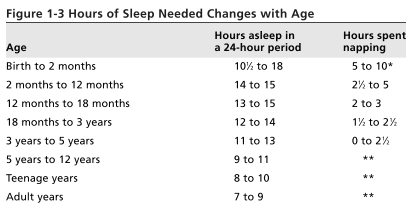
Data obtained from several sources, including sleepfoundation.org
Written and revised by
Andrey Nailor, M.D.
Our doctors write and review articles for accuracy and keep them up to date.
health.am provides general information, not medical advice. Always consult a qualified health professional about your own health.
Explore health topics
More in this topic
Sleep → News
Workplace intervention improves sleep of employees' children
A workplace intervention designed to reduce employees' work-family conflict and increase schedule flexibility also has a positive influence on the sleep patterns of the employees' children. The intervention,…
22 May 2015
 News
Study shows that children sleep better when they have a nightly bedtime routine
A multinational study suggests that having a regular bedtime routine is associated with better sleep in young children up to 6 years of age, and the positive impact on sleep increases with the consistency of the nightly…
7 May 2015
NewsNatural sleep cycles identified in rural community - new study finds
A new study, published today in the journal Scientific Reports, has identified a rural community in Brazil that still follows the earlier sleep and wake times similar to pre-industrial times. The team of researchers…
18 March 2015





