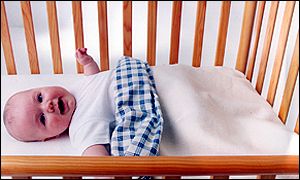
Cry babies 'learn to sleep better'
Key points
- Mothers who learn to let their babies cry themselves to sleep have better nights and suffer less postnatal depression, research suggests.
- Other studies suggest half of parents had problems with their child's sleep between six months and a year.
- Cheryll Adams, of the Community Practitioners and Health Visitors Association (CPHVA), said the study showed the importance of supporting new mothers.
- A report in the British Medical Journal found that teaching mothers "controlled crying" techniques significantly reduced sleep problems.
Mothers who learn to let their babies cry themselves to sleep have better nights and suffer less postnatal depression, research suggests.
A report in the British Medical Journal found that teaching mothers "controlled crying" techniques significantly reduced sleep problems.
Two generations ago, leaving babies to cry was the favoured method for teaching children to sleep and many experts agree it can work well again if mothers are properly supported.
The Australian researchers studied 156 mothers with children, aged between 6 and 12 months, suffering from severe sleep problems.
They gave one group advice on how to let their babies cry, sleep management plans, information on normal sleep patterns and how to manage problems.
The other group was simply told about normal sleep patterns, but got no advice on managing the problems.
Sleep problems
Other studies suggest half of parents had problems with their child's sleep between six months and a year.
And up to 15% of mothers were suffering from postnatal depression.
Both of these were having a detrimental effect on family life, leading in some cases to marital stress, family breakdowns, child abuse; behavioural problems and maternal anxiety.
Paediatrician Dr Harriet Hiscock and her team taught parents "controlled crying techniques" - how to respond to an infant's cry at increasing time intervals to teach it to fall asleep alone.
She also advocated consistent daytime naps and bedtime routines.
The parents were asked to keep sleep diaries and routines were individually tailored to meet families' needs.
They found they were able to solve nearly 90% of the babies' sleep problems by using the controlled crying methods, meaning far fewer women needing help for postnatal depression.
Dr Hiscock recommended the system to other professionals.
"The intervention reduced the need for other professional sleep services, was acceptable to mothers, was of low cost and was minimally disruptive to families in contrast with many current strategies for postnatal depression," she said.
She added she would now like to see the study extended.
Mothers can become very vulnerable
Cheryll Adams of the CPHVA
Health problems
Cheryll Adams, of the Community Practitioners and Health Visitors Association (CPHVA), said the study showed the importance of supporting new mothers.
Mothers who were not getting enough sleep tended to become more stressed and suffer more from mental health problems, she said.
Written and revised by
Gerald Hurowitz, M.D.
Our doctors write and review articles for accuracy and keep them up to date.
health.am provides general information, not medical advice. Always consult a qualified health professional about your own health.
Explore health topics
More in this topic
Sleep → News
Prenatal stress may affect babies' sleep
A mother's anxiety or depression during pregnancy may affect her child's sleep patterns early in life, a new study suggests. Researchers found that babies and toddlers whose mothers had such symptoms during pregnancy…
11 August 2007
 News
Learning During Sleep?
Max Planck researchers in Heidelberg are investigating communication between memory areas during sleep If I can't remember this morning where I put my car keys last night, it's due to my memory failing me again.…
6 December 2006
 News
Fat children sleep better when they exercise
Researchers in the United States say that doing some form of aerobic exercise during the daytime might improve the sleep-related breathing problems experienced by many children who are overweight or obese. Catherine L.…
29 November 2006