
Scientists identify first gene linked to scoliosis
Key points
- Physicians have recognized scoliosis, the abnormal curvature of the spine, since the time of Hippocrates, but its causes have remained a mystery - until now.
- The new finding lays the groundwork for determining how a defect in the gene - known as CHD7 - leads to the C- and S-shaped curves that characterize scoliosis.
- "Hopefully, we can now begin to understand the steps by which the gene affects spinal development," says Anne Bowcock, Ph.D., professor of genetics, of medicine and of pediatrics.
- The researchers have traced a defect in CHD7 to idiopathic scoliosis, the form of the condition for which there is no apparent cause.
Physicians have recognized scoliosis, the abnormal curvature of the spine, since the time of Hippocrates, but its causes have remained a mystery - until now. For the first time, researchers have discovered a gene that underlies the condition, which affects about 3 percent of all children.
The new finding lays the groundwork for determining how a defect in the gene - known as CHD7 - leads to the C- and S-shaped curves that characterize scoliosis. The gene's link to scoliosis was identified by scientists at Washington University School of Medicine in St. Louis, working in collaboration with investigators at the University of Texas Southwestern Medical Center and Texas Scottish Rite Hospital for Children, both in Dallas, Rutgers State University of New Jersey and the University of Iowa. The group published its results in May in the American Journal of Human Genetics.
"Hopefully, we can now begin to understand the steps by which the gene affects spinal development," says Anne Bowcock, Ph.D., professor of genetics, of medicine and of pediatrics. "If we understand the genetic basis of the condition, we can theoretically predict who is going to develop scoliosis and develop treatments to intervene before the deformity sets in. It may take many years to accomplish these goals, but I think it will eventually happen."
The researchers have traced a defect in CHD7 to idiopathic scoliosis, the form of the condition for which there is no apparent cause. It is the most common type of scoliosis, occurs in otherwise healthy children and is typically detected during the growth spurt that accompanies adolescence.
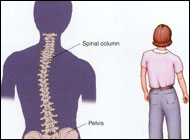
Although scientists have known for years that scoliosis runs in families, its pattern of inheritance has remained unclear. That's because the condition is likely caused by several different genes that work in concert with one another - and the environment - to cause scoliosis. Bowcock predicts that scientists will soon find other genes involved in the disease.
The CHD7 gene is thought to play a critical role in many basic functions in the cell. The researchers zeroed in on the gene after finding that it is missing or profoundly disrupted in a rare syndrome called CHARGE. Babies born with the syndrome often die in infancy. Those that survive have heart defects, mental retardation, genital and urinary problems, ear abnormalities and deafness, among other problems. They also develop late-onset scoliosis.
"This led us to consider that milder variations of CHD7 may be involved in other types of scoliosis," Bowcock said.
The researchers, led by Carol Wise, Ph.D., at Scottish Rite Hospital, collected data on 52 families with a history of scoliosis in at least two members - the one who sought treatment and another from earlier generation. The patients had an average spinal curvature of 40 degrees and did not have any illnesses, such as Marfan syndrome or cerebral palsy, which can also involve scoliosis. The researchers performed genome-wide scans that spelled out the 6 billion letters of genetic code in the affected family members and analyzed the data.
Written and revised by
David Cohen, M.D.
Our doctors write and review articles for accuracy and keep them up to date.
health.am provides general information, not medical advice. Always consult a qualified health professional about your own health.