
Medical-information chips implanted in Florida family
Key points
- With a painless syringe-prick in their upper arms, a Florida family on Friday became the first recipients of tiny, computer chip implants that store medical information.
- Jeff and Leslie Jacobs, along with their 14-year-old son, Derek, had the chips, about the size of a grain of rice, implanted in about a minute under local anesthesia.
- The family wanted the implants in case of future medical emergencies.
- The implant, called the VeriChip, were designed by Palm Beach-based Applied Digital Solutions Inc.
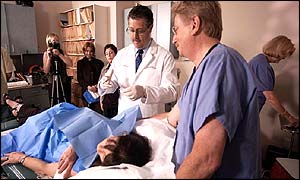
With a painless syringe-prick in their upper arms, a Florida family on Friday became the first recipients of tiny, computer chip implants that store medical information.
Jeff and Leslie Jacobs, along with their 14-year-old son, Derek, had the chips, about the size of a grain of rice, implanted in about a minute under local anesthesia.
The family wanted the implants in case of future medical emergencies.
The implant, called the VeriChip, were designed by Palm Beach-based Applied Digital Solutions Inc. The chips are similar to chips implanted in pets to identify them if they are lost.
Jeff Jacobs is a 48-year-old dentist who has suffered through cancer, a car crash, a degenerative spinal condition, chronic eye disease and abdominal operations. He is on 10 medications, and doctors have told him they are not sure how long he will live.
"We're doing this as a security for us, because we've worked so hard to save my husband's life," said Leslie Jacobs, 46.
The Jacobs family's chips contain only telephone numbers and information about previous medications.
The VeriChip doesn't require batteries and its data is read by a scanning device which can be Internet-connected to access a medical record database. Patients would pay a fee to keep private medical information in the database, but would be able to update and manage their own records.
For now, patients or their families would have to tell emergency medical workers that a chip had been implanted, VeriChip officials said. If the use of such chips ever become commonplace, emergency workers might automatically scan for the devices.
The Food and Drug Administration said in April that it would not regulate the implant as long as it contains no medical data.
The FDA did not consider the implant to be a medical device, company officials said. An FDA spokeswoman in Miami did not return a phone call Friday.
Company officials hope to eventually include more extensive information. The company says it would be particularly valuable for those who suffer from Alzheimer's disease or others with difficulty providing medical information on their own.
VeriChip, which does not require batteries, is expected to sell for about $200. A scanner used to read its information would cost between $1,000 and $3,000.
The chip, which could also be used as a security tool, has stirred debate over its potential use as a "Big Brother" device to track people or invade the privacy of their homes or workplaces.
Jacobs and his family brushed aside those arguments, saying anyone can be tracked through the Internet and e-mail, credit cards and cellular phones.
Written and revised by
Gerald Hurowitz, M.D.
Our doctors write and review articles for accuracy and keep them up to date.
health.am provides general information, not medical advice. Always consult a qualified health professional about your own health.