Gerald Hurowitz, M.D.·Published 26 March 2015·11 min read
Key points
Cancer is a disease that you should never take lightly.
Normal body cells grow, divide to make new cells, and die in an orderly way.
Recent decades have seen a substantial decline in the number of children being born to women in developed countries.
We now know that alcohol can increase your risk of a number of cancers.
Cancer is a disease that you should never take lightly. There are cases where it strikes quickly but often, cancer manifests after years of specific habits. Good examples of this are smoking and overexposure to ultraviolet rays, which result in lung cancer and skin cancer, respectively.
Experts estimate that more than half the cases of cancer diagnosed in the United States - more than 1.6 million in 2014 - are preventable with lifestyle changes.
There is one area of your daily life that dramatically affects your - and survival - of cancer. The food and beverages you consume, the fuel your body uses to fight disease, is critical to your overall wellbeing. Some foods are worse for you than others and could be increasing your risk of many conditions and diseases. While cancer is one of the worst, regularly eating the foods in our top ten list can also lead to heart disease, diabetes, and chronic inflammation.
Cancer is the general name for a group of more than 100 diseases. Although there are many kinds of cancer, all cancers start because abnormal cells grow out of control. Untreated cancers can cause serious illness and death.
Normal cells in the body
The body is made up of trillions of living cells. Normal body cells grow, divide to make new cells, and die in an orderly way. During the early years of a person’s life, normal cells divide faster to allow the person to grow. After the person becomes an adult, most cells divide only to replace worn-out or dying cells or to repair injuries.
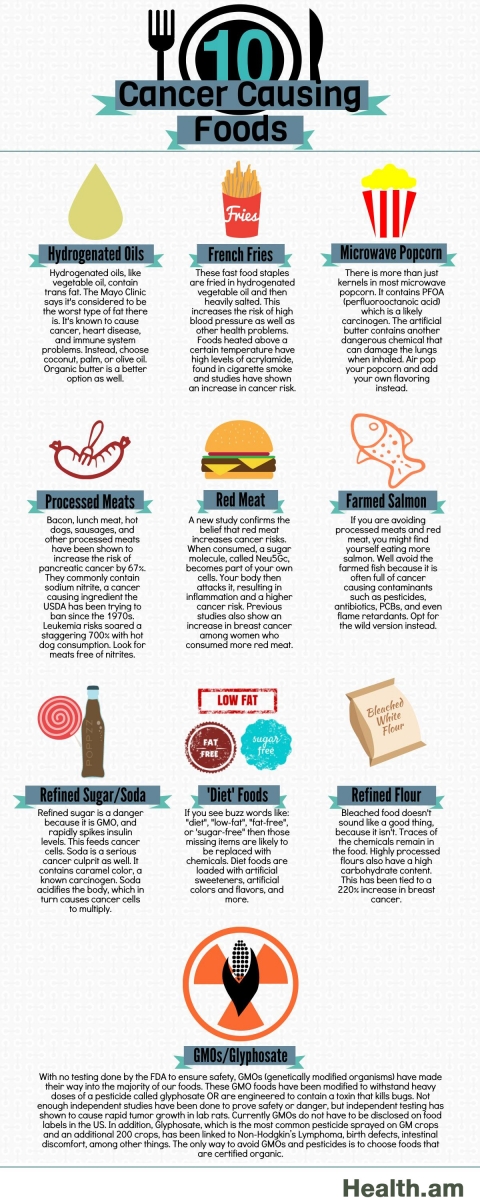
Top 13 Cancer Causing Foods to Avoid
1. Genetically Modified Foods (GMOs): The rapidly growing industry of genetically modified crops are infiltrating our food supply at an alarming rate. More than 90% of our corn and soy are now genetically modified. This fairly new practice is the source of many debates. Experts agree that adequate testing was not done before GMO foods were added to the ingredient listing of thousands of products. Look for GMO-free labels whenever possible. See our exclusive report on the dangers of GMO foods.
2. Microwave Popcorn: From the chemical-lined bag to the actual contents, microwave popcorn is at the center of lung cancer debates around the world. Not only are the kernels and oil likely GMO (which the manufacturer does not have to disclose), but the fumes released contain diacetyl, which is toxic to humans.
Those little bags of popcorn are so convenient to just stick in the microwave, you wouldn't think for a minute that they could be dangerous to your health, but they are.
First, let's talk about the bag itself. According to Wikipedia, conventional microwave popcorn bags are lined with a chemical called perfluorooctanoic acid ( PFOA). This is a toxin you can find in Teflon also. According to a recent study at the University of California, . Numerous studies in lab animals and humans show that exposure to PFOA significantly increases the risk of kidney, bladder, liver, pancreas and testicular cancers. You can read more about this substance and the above mentioned studies at cancer.org.
Written and revised by
Gerald Hurowitz, M.D.
Our doctors write and review articles for accuracy and keep them up to date.
health.am provides general information, not medical advice. Always consult a qualified health professional about your own health.
Now, let's talk about the contents. Although every manufacturer uses slightly different ingredients, most of them use soybean oil (a GMO product) as well as various preservatives such as propyl gallate, a chemical that is causes stomach problems and skin rashes. Now they don't actually say they are using GMO corn kernels, but that's because the government says they don't have to. Even if they don't use GMO corn, you can bet they aren't using organic corn!
Also, applied to the popcorn itself, is a chemical called diacetyl. Use of this chemical caused Conagra Foods to remove it from their brand of popcorn, ACT, because it was causing lung diseases in the workers at their factory.
3. Canned Goods: Most cans are lined with a product called bisphenol-A (BPA), which has been shown to genetically alter the brain cells of rats. Many plastic goods, thermal paper, water lines, and many dental composites also contain BPA.
Coke and Pepsi products may soon bear cancer warnings in California California's Proposition 65 law limits the consumption of 4-MI to no more than 16 micrograms per day from a single product. Yet colas contain roughly 200 micrograms of 4-MI in a 20-ounce bottle.
That's over 12 times the allowable limit under Proposition 65, and that's in every bottle! Many people drink several bottles a day, further multiplying their exposure to this potential carcinogen.
If cola companies are going to continue to sell their products in California, then, they must now carry cancer warning labels in order to be in compliance with Prop 65. You can bet that a desperate effort is now under way by the cola industry to lobby California regulators and make sure 4-MI gets removed from any enforcement of Prop 65.
The cola industry wants everybody to think its products are wholesome and natural while forgetting about the health effects of phosphoric acid, aspartame and high-fructose corn syrup. Now, with 2-methylimidazole and 4-methylimidazole in the picture, there's yet another potentially cancer-causing chemical to worry about in colas.
4. Grilled Red Meat: While grilling tastes delicious, scientists have discovered that preparing meats in this way - especially processed meats like hot dogs - releases a carcinogen called heterocyclic aromatic amines. When you grill red meat to the point of well-done, it changes the chemical and molecular structure of the meat.
Study Associates PFOS and PFOA with Impaired Fertility
Recent decades have seen a substantial decline in the number of children being born to women in developed countries. Much of this decline is likely attributable to sociocultural changes and increased access to birth control. But some studies suggest that exposure to environmental pollutants may play a role, perhaps by impairing fecundity, the ability to bear live children. Now a study by researchers at the University of California, Los Angeles (UCLA) has found that women who took longer to become pregnant were more likely to have higher blood levels of two common perfluorinated chemicals, perfluorooctane sulfonate (PFOS) and perfluorooctanoate (PFOA).
PFOS and PFOA are persistent manmade pollutants widely found in fabrics, carpets, food packaging, shampoo, nonstick cookware, insecticides, fire?fighting foam, and other household products, as well as in industrial surfactants and emulsifiers. Potential major sources of PFOA in the environment include the degradation of fluorinated alcohols used in these products. Animal studies have associated both PFOS and PFOA with increased pregnancy losses and disruption in sex hormone homeo?stasis and sexual maturation. Although previous studies have linked pollutants such as pesticides and polychlorinated biphenyls with delayed time to pregnancy, the UCLA study is the first to demonstrate a similar relationship with perfluorinated chemicals.
In the current study, the researchers measured maternal blood concentrations of PFOA and PFOS in 1,240 pregnant women who participated in the Danish National Birth Cohort from 1996 to 2002. Blood samples were drawn from weeks 4 through 14 of pregnancy, and women were asked at approximately week 12 how long it had taken to conceive and whether the pregnancy was planned.
{pagebreak}
5. Refined Sugar: The biggest threat is high-fructose corn syrup (HFCS) but even brown sugar is highly refined white sugar with some of the removed molasses added back in for flavor and color. They are the source of major insulin spikes and feed the growth of cancer cells. Since the majority of the sugar supply in the U.S. is made using genetically modified (GMO) sugar beets, a healthier option is organic honey, coconut sugar, or maple sugar.
Artificial Sweeteners and CancerIs there an association between artificial sweeteners and cancer?
Questions about artificial sweeteners and cancer arose when early studies showed that cyclamate in combination with saccharin caused bladder cancer in laboratory animals. However, results from subsequent carcinogenicity studies (studies that examine whether a substance can cause cancer) of these sweeteners have not provided clear evidence of an association with cancer in humans. Similarly, studies of other FDA-approved sweeteners have not demonstrated clear evidence of an association with cancer in humans.
What have studies shown about a possible association between specific artificial sweeteners and cancer?
Saccharin
Studies in laboratory rats during the early 1970s linked saccharin with the development of bladder cancer. For this reason, Congress mandated that further studies of saccharin be performed and required that all food containing saccharin bear the following warning label: "Use of this product may be hazardous to your health. This product contains saccharin, which has been determined to cause cancer in laboratory animals."
Subsequent studies in rats showed an increased incidence of urinary bladder cancer at high doses of saccharin, especially in male rats. However, mechanistic studies (studies that examine how a substance works in the body) have shown that these results apply only to rats. Human epidemiology studies (studies of patterns, causes, and control of diseases in groups of people) have shown no consistent evidence that saccharin is associated with bladder cancer incidence.
Because the bladder tumors seen in rats are due to a mechanism not relevant to humans and because there is no clear evidence that saccharin causes cancer in humans, saccharin was delisted in 2000 from the U.S. National Toxicology Program's Report on Carcinogens, where it had been listed since 1981 as a substance reasonably anticipated to be a human carcinogen (a substance known to cause cancer).
6. Salted, Pickled, and Smoked Foods: These products typically contain preservatives, such as nitrates, which are intended to prolong shelf life. The additives used in processed foods can accumulate in your body over time. Eventually, such toxins cause damage at the cellular level and lead to diseases like cancer. When smoked foods are cooked at high temperatures, the nitrates are converted to the much more dangerous nitrites.
7. Soda and Carbonated Beverages: Sodas have been at the center of the health debate for two decades. Filled with high-fructose corn syrup (HFCS), dyes, and a host of other chemicals, they are very bad for your health. They provide zero nutritional value and can rob your body of the nutrients you get from other foods. Adding "diet" to the label means you're also consuming aspartame - and that is no better than rat poison.
8. White Flour: When flour is refined, all nutritional value is removed and then it is bleached with chlorine gas to make it more appealing to consumers. The glycemic index for white flour is very high - meaning it spikes your insulin levels without providing nutritional fuel. Carbohydrates are converted to sugars by your body, so excessive products that contain white flour can lead to increased insulin resistance.
9. Farmed Fish: Commercial fish farming involves raising an incredible number of fish - such as salmon - in a crowded environment. 60% of the salmon consumed come from a farming operation where they are treated with antibiotics, pesticides, and other carcinogenic chemicals. They also do not contain as much omega-3 as wild salmon.
10. Hydrogenated Oils: Vegetable oils are chemically extracted from their source, then they are chemically treated, and then more chemicals are added to change the smell and taste. They are packed with unhealthy omega-6 fats and have been proven to alter the structure of our cell membranes.
11. Potato chips: They may be cheap, easy and delicious, but these crispy, addicting snacks can also be deadly. These fatty foods don't only cause weight gain because of their high trans-fat content, they also have excessive sodium levels, which cause high blood pressure and artificial flavors, preservatives and colors. Another risk is the presence of acrymalide, a known carcinogen found in cigarettes. Try not to feed these quick snacks to yourself or your kids and choose pretzels, air-popped popcorn or baked apple chips instead.
12. ANYTHING "diet": You may be thinking you're doing the right thing when choosing a food with a "diet" or "low-fat" label, but you're actually doing way more harm than good. Chemical artificial sweetener aspartame, again, is the big culprit, causing cancer, birth defects and heart problems. Think about it - anything "diet" is chemically processed and not REAL food. These foods also contain additives like ones found in cocaine to make you feel good, but also be addicting. Be smart and eat nature's delicious, natural foods - organic only, of course!
Any food that is listed as "diet," "light," or "fat-free" should be avoided. In order to remove fat or natural calories, they are replaced with chemicals that are dangerous to your body. Instead of eating food that manufacturers profess is "good for you" - add organic fruits and vegetables, grass-fed meats, and organic dairy products.
13. Alcohol: Alcohol use is the second leading cause of cancer, right behind tobacco use. While a moderate or low consumption of alcohol can be healthy and lead to a reduced risk of heart disease, excessive drinking is known to cause heart failure, stroke, and sudden death. Excessive alcohol use is the biggest cause of mouth, esophagus, liver, colon, mouth, rectum and breast cancers. Don't worry! You don't need to give up your glass of wine with dinner, but, for your health's sake, stick to one.
Alcohol and cancer
We now know that alcohol can increase your risk of a number of cancers. A review in 2011 by Cancer Research UK suggests that around 4 out of 100 cancers (4%) are linked to alcohol. It increases the risk of mouth cancer, liver cancer, breast cancer, bowel cancer, and throat cancer, which includes pharyngeal cancer, laryngeal cancer and cancer of the food pipe (oesophagus).
Even moderate alcohol intake increases your risk of cancer. A recent UK study showed that women who drink 1 or 2 drinks a day have a slightly increased risk of cancer.
Small changes will change how you feel (and look) from the inside out. Now that you know what the top cancer causing foods are, isn't it about time to choose healthy food ingredients?

 News
 News
 News