The epidemiological link between obesity and diabetes
Key points
- The link between obesity prevalence and rates of diabetes in different populations was demonstrated by West with an increase in the prevalence of type 2 diabetes as the population becomes more obese (West, 1978; Figure 1.2).
- Within populations there is clear evidence of a strongly positive relationship between obesity and the risk of diabetes.
- Figure 1.1 Prevalence of obesity in the UK from 1980 to 1997 from Joint Health Surveys Unit on behalf of the Department of Health 1999.
- Data from NHANES shows that for each kilogram increase in weight of the population the risk of diabetes increases by 4.5 per cent (Ford et al., 1997).
The link between obesity prevalence and rates of diabetes in different populations was demonstrated by West with an increase in the prevalence of type 2 diabetes as the population becomes more obese (West, 1978; Figure 1.2). Whilst there are changes in the incidence of type 1 diabetes, it is type 2 diabetes that is largely responsible for the global epidemic of diabetes.
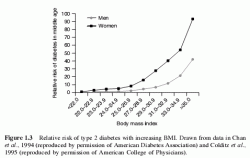
Within populations there is clear evidence of a strongly positive relationship between obesity and the risk of diabetes. Data in the United States from the Health Professionals' Follow-up Study in men (Chan et al., 1994) and the Nurses' Health Study in women (Colditz et al., 1995) graphically illustrates the increasing risk of diabetes that obesity brings (Figure 1.3). Compared with those of a BMI less than 21, women with a BMI greater than 35 had a 93-fold excess risk of developing diabetes. The risk of developing type 2 diabetes rises progressively with increasing adiposity (whether assessed by BMI, or percentage of ideal body weight).
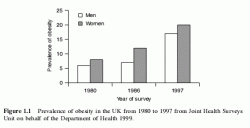
Figure 1.1 Prevalence of obesity in the UK from 1980 to 1997 from Joint Health Surveys Unit on behalf of the Department of Health 1999.
Data from NHANES shows that for each kilogram increase in weight of the population the risk of diabetes increases by 4.5 per cent (Ford et al., 1997).
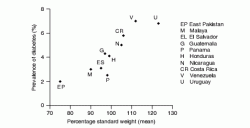
Figure 1.2 Graph showing the relationship between the prevalence of diabetes (predominantly type 2 diabetes) and body weight in 10 representative populations. Body weight is expressed as the population mean, relative to a 'standard' weight that is given an arbitrary score of 100. Reproduced from West 1978 by permission of Elsevier Science.
More recent examination of diabetes trends in the US showed an even steeper increment of diabetes risk with weight gain, with a 9 per cent increased risk of diabetes for each kilogram of body weight gain (Mokdad et al., 2000). Whether this large difference is a real phenomenon, or is explained by increased public awareness of diabetes is not clear, as the later study depended on telephone surveys.
Where populations have changed their lifestyle and become more obese (e.g. Pima Indians of Arizona, Micronesian Nauruan Islanders) an epidemic of type 2 diabetes has followed on. Groups that were previously lean and had a low incidence of diabetes have become obese diabetics. 80 per cent of adult Pima Indians are now obese and 40 per cent of this population now has type 2 diabetes (Zimmet, 1982). In comparison, a genetically almost identical Pima Indian population in Mexico has been described who are lean and whose incidence of type 2 diabetes is virtually zero (Ravussin et al., 1994; Esparza et al., 2000). The importance of obesity in the development of diabetes is clearly demonstrated.
Written and revised by
Andrey Nailor, M.D.
Our doctors write and review articles for accuracy and keep them up to date.
health.am provides general information, not medical advice. Always consult a qualified health professional about your own health.
Explore health topics
More in this topic
Weight & Nutrition → News
Obesity linked to increased health care costs after plastic surgery
After common plastic surgery procedures, obese patients have more complications and make more hospital visits--leading to higher healthcare costs, reports a study in the May issue of Plastic and Reconstructive Surgery®,…
1 May 2015
 News
Keeping food visible throughout the house is linked to obesity
Researchers have identified two seemingly unrelated but strong predictors of obesity: having low self-esteem related to one's weight and keeping food visibly available around the house, outside the kitchen. The Ohio…
29 April 2015
 News
Obesity Linked to Low Endurance, Increased Fatigue in the Workplace
U.S. workplaces may need to consider innovative methods to prevent fatigue from developing in employees who are obese. Based on results from a new study published in the Journal of Occupational and Environmental Hygiene…