
The challenge of swimming the Channel
Key points
- Our knowledge of the human body has improved a touch since Matthew Webb, the Shropshire-born son of a surgeon, became the first person to swim unaided across the English Channel in 1875.
- As a low point for Stephen, it was surpassed only by the feeling of missing the peninsula of Cap Gris Nez by a mile and being thrown out into the bay beyond it, adding two hours to his swim.
- Channel grease (a mixture of Vaseline and wool fat) is used instead the porpoise oil with which Webb smeared his body for insulation and ease of movement.
- And the mixture of cherry brandy and beaten eggs that early swimmers used to consume has, mercifully, been replaced by complex carbohydrate liquid food, vitamins and pain killers.
Our knowledge of the human body has improved a touch since Matthew Webb, the Shropshire-born son of a surgeon, became the first person to swim unaided across the English Channel in 1875.
Channel grease (a mixture of Vaseline and wool fat) is used instead the porpoise oil with which Webb smeared his body for insulation and ease of movement.
And the mixture of cherry brandy and beaten eggs that early swimmers used to consume has, mercifully, been replaced by complex carbohydrate liquid food, vitamins and pain killers.
But the fact remains that swimming the 22 nautical miles between Dover and Cap Gris Nez - the shortest distance between England and France - remains one of the hardest and most prestigious endurance events in the world.
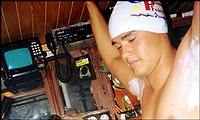
For years Stephen Hunt, a 21-year-old actor in the Australian soap Neighbours, had heard stories of the challenge and, as junior Australia swimmer, had dreamed of making the crossing.
Last month that dream became a reality, though for long stretches it was closer to the stuff of nightmares.
To most observers, the tale of Stephen's swim across the Channel is a clear example of a precocious young Aussie taking his body beyond its physical limits.
On the other hand, it is also a clear example of the power of mind over body.
On Stephen's back were written the words "For Bill", a reference to his uncle, Bill Hunt, who died of Aids 15 years ago.
The swim was a way of honouring his uncle's life and raising money for various Aids charities, including the Terence Higgins Trust.
Without that motivation it is doubtful he would have made it.
If anyone is crazy enough to think that joining the 100 or so people who swim the Channel each year would be an enjoyable experience consider the following:
- All swimmers develop some degree of hypothermia, an abnormally low body temperature.
- The quickest realistic time to make the crossing is 10hrs - Stephen took 12hrs 12mins.
- At no time, including during feeding, is a swimmer allowed to touch the escort boat.
- Stephen was stung by jelly fish seven times, including once in his trunks.
And if all those are successfully negotiated, there is also sea sickness, diesel fumes, passing tankers, flotsam and swelling of the throat from swallowing salt water to contend with.
A handful of people have died attempting the swim.
These include Swiss Ueli Staub, who died last year after taking caffeine pills as a stimulant and suffering a heart attack.
However, the greatest obstacle is the mental battle.
Written and revised by
Gerald Hurowitz, M.D.
Our doctors write and review articles for accuracy and keep them up to date.
health.am provides general information, not medical advice. Always consult a qualified health professional about your own health.
Explore health topics
More in this topic
Weight & Nutrition → News
Weight loss through diet changes can improve sleep at any body weight, says Penn study
Weight loss due to dietary changes can improve sleepiness at any weight, says a study published by researchers from the Perelman School of Medicine at the University of Pennsylvania this month in the journal Sleep. The…
17 December 2015
 News
Earlier intervention leads to better weight recovery in children with multiple risk factors for weight faltering
Young children who are underweight experienced greater weight recovery the earlier an intervention was started, and the recovery was more significant in children with multiple household risk factors, according to a…
12 December 2015
 News
One in 10 globally suffer from foodborne diseases, WHO study finds
One out of every 10 people worldwide suffer from foodborne diseases annually, and children and the poor suffer most, according to the findings of a World Health Organization task force headed by a University of Florida…





