
Rate of severe childhood obesity up sharply in U.S.
Key points
- The rate of severe obesity among U.S. children and teenagers more than tripled over the past three decades, a new study finds.
- Using data from a long-running government health survey, researchers found that as of 2004, nearly 4 percent of 2- to 19-year-olds in the U.S. were severely obese.
- That was up more than three-fold from 1976, and more than 70 percent from 1994, the researchers report in the journal Academic Pediatrics.
- "Children are not only becoming obese, but becoming severely obese, which impacts their overall health," lead researcher Dr.
The rate of severe obesity among U.S. children and teenagers more than tripled over the past three decades, a new study finds.
Using data from a long-running government health survey, researchers found that as of 2004, nearly 4 percent of 2- to 19-year-olds in the U.S. were severely obese.
That was up more than three-fold from 1976, and more than 70 percent from 1994, the researchers report in the journal Academic Pediatrics.
"Children are not only becoming obese, but becoming severely obese, which impacts their overall health," lead researcher Dr. Joseph A. Skelton, of Wake Forest University School of Medicine in Winston-Salem, North Carolina, said in a news release from the university.
"These findings," he added, "reinforce the fact that medically-based programs to treat obesity are needed throughout the United States and insurance companies should be encouraged to cover this care."
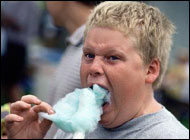
The study also found that minority and lower-income children are at particular risk of severe obesity - which, in children and teenagers, is defined as having a body mass index (BMI) in the 99th percentile for one's age and gender.
In the most recent survey, which included 12,000 2- to 19-year-olds from across the U.S., nearly 6 percent of African-American children and teens were severely obese, as were roughly 5 percent of Mexican- Americans. That compared with 3 percent of their white peers.
In contrast, less than 1 percent of Mexican-American children and less than 2 percent of black children were severely obese in the 1970s survey.
When it came to family income, the latest survey data show that just over 4 percent of relatively lower-income children were severely obese, versus 2.5 percent of those from higher-income families.
The findings underscore a central obstacle in tackling childhood obesity, Skelton and his colleagues note: The children who are most affected also generally have the greatest difficulty getting good healthcare.
"No simple answers exist," the researchers write, pointing out that along with better access to healthcare, there also need to be broader efforts to improve the diets and lifestyle habits of U.S. children.
SOURCE: Academic Pediatrics, September 2009.
Written and revised by
Gerald Hurowitz, M.D.
Our doctors write and review articles for accuracy and keep them up to date.
health.am provides general information, not medical advice. Always consult a qualified health professional about your own health.
Explore health topics
More in this topic
Weight & Nutrition → News
New strategic plan for NIH obesity research seeks to curb epidemic
To combat the obesity epidemic, the National Institutes of Health is encouraging diverse scientific investigations through a new Strategic Plan for NIH Obesity Research. More than one-third of adults in the United…
1 April 2011
NewsStudy: Global obesity rates double since 1980
The world is becoming a heavier place, especially in the West. Obesity rates worldwide have doubled in the last three decades even as blood pressure and cholesterol levels have dropped, according to three new studies.…
10 February 2011
 News
We need to listen to doctors and lower smoking and obesity rates
A recent message from the acting chief of professional staff at Bluewater Health offered a strong message about the dire need to decrease obesity and smoking rates in Sarnia-Lambton. Dr. Michel Haddad said it will take…





