
Pistachios may lower vascular response to stress in Type 2 diabetes
Key points
- Eating pistachios may reduce your body's response to the stresses of everyday life, according to a Penn State study conducted by principal investigator Sheila G.
- "In adults with diabetes, two servings of pistachios per day lowered vascular constriction during stress and improved neural control of the heart," West said.
- West and her colleagues investigated the effects of pistachios on responses to standardized stress tasks in patients with well-controlled Type 2 diabetes who were otherwise healthy.
- After two weeks on the typical American diet (containing 36 percent fat and 12 percent saturated fats), participants were randomized to one of two test diets.
Eating pistachios may reduce your body's response to the stresses of everyday life, according to a Penn State study conducted by principal investigator Sheila G. West, professor of biobehavioral health and nutritional sciences.
"In adults with diabetes, two servings of pistachios per day lowered vascular constriction during stress and improved neural control of the heart," West said. "Although nuts are high in fat, they contain good fats, fiber, potassium, and antioxidants. Given the high risk of heart disease in people with diabetes, nuts are an important component of a heart healthy diet in this population."
West and her colleagues investigated the effects of pistachios on responses to standardized stress tasks in patients with well-controlled Type 2 diabetes who were otherwise healthy. They used a randomized, crossover study design in which all meals were provided. Each of the diets contained the same number of calories.
After two weeks on the typical American diet (containing 36 percent fat and 12 percent saturated fats), participants were randomized to one of two test diets. During the four-week test diets, participants ate only food supplied by the study. The researchers reported the results of this study in the Journal of the American Heart Association on June 30, 2014.
Test diets included a standard heart-healthy diet (27 percent fat and 7 percent saturated fat) and a diet containing two servings per day of pistachios (about 3 ounces or 20 percent of calories from pistachio nuts). The typical research participant consumed about 150 pistachio nuts per day. The pistachio diet contained 33 percent fat and 7 percent saturated fat. Half of the nuts consumed each day were salted and half were unsalted. At the end of each four-week diet period, the researchers measured blood pressure and total peripheral vascular resistance at rest and during two stress tests: a cold water challenge and a confusing mental arithmetic test.
"After the pistachio diet, blood vessels remained more relaxed and open during the stress tests," West said.
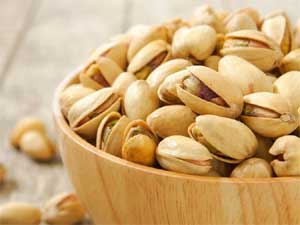
Although laboratory measurements of blood pressure were not affected by pistachios, real-world measures of blood pressure (measured by an automated monitor) were significantly lower after the pistachio diet. Katherine A. Sauder, a co-investigator on the project, conducted these measurements.
"We found that systolic blood pressure during sleep was particularly affected by pistachios," she said. "Average sleep blood pressure was reduced by about 4 points and this would be expected to lower workload on the heart."
The researchers found that the pistachio diet lowered vascular constriction during stress. When arteries are dilated, this reduces the load on the heart. The physical challenge involved immersing one hand into icy water for two minutes.
Written and revised by
David Cohen, M.D.
Our doctors write and review articles for accuracy and keep them up to date.
health.am provides general information, not medical advice. Always consult a qualified health professional about your own health.
Explore health topics
More in this topic
Weight & Nutrition → News
Consuming Coffee Linked to Lower Risk of Detrimental Liver Disease, Mayo Clinic Finds
Regular consumption of coffee is associated with a reduced risk of primary sclerosing cholangitis (PSC) , an autoimmune liver disease, Mayo Clinic research shows. The findings were being presented at the Digestive…
20 May 2013
 News
Dieting youth show greater brain reward activity in response to food
The story is a familiar one: most people are able to lose weight while dieting but once the diet is over, the weight comes back. Many of us can personally attest that caloric deprivation weight loss diets typically do…
3 May 2013
NewsRaw fruit may not be linked to lower blood pressure
People who eat more raw fruits or drink juice do not necessarily have lower blood pressure, according to a new study that goes against previous evidence. Larger, more rigorous studies have found that eating more fruits…



