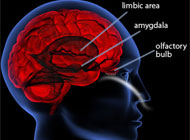
Obesity Research Boosted By Watching Hunger In The Brain

Key points
- Scientists can now measure how full or hungry a mouse feels, thanks to a new technique which uses imaging to reveal how neurons behave in the part of the brain which regulates appetite.
- Researchers hope the technique, which uses magnetic resonance imaging, will enable a far greater understanding of why certain people become obese when others do not, and why different people have different appetites.
- The new study, led by researchers from Imperial College London, is described in a paper published November 7 in the Journal of Neuroscience.
- It had previously been very difficult to measure satiety, which is the psychological feeling of being full and satisfied rather than physical fullness.
Scientists can now measure how full or hungry a mouse feels, thanks to a new technique which uses imaging to reveal how neurons behave in the part of the brain which regulates appetite.
Researchers hope the technique, which uses magnetic resonance imaging, will enable a far greater understanding of why certain people become obese when others do not, and why different people have different appetites.
The new study, led by researchers from Imperial College London, is described in a paper published November 7 in the Journal of Neuroscience.
It had previously been very difficult to measure satiety, which is the psychological feeling of being full and satisfied rather than physical fullness. To judge satiety scientists have relied on asking volunteers in trials how full they feel, or watching how much food is eaten, rather than using more objective measures.
Scientists had already identified the part of the hypothalamus area of the brain which regulates appetite. In the new study, the researchers discovered that they could see the neurons there firing if they used a contrast agent of manganese ion to make the neurons visible on a magnetic resonance imaging scan.
When the mouse was hungry and hence the neurons showed increased activity, the contrast agent was taken up, making the neurons 'light up' on the scan. The intensity of this signal decreased as the mouse became less hungry and the neurons became less active.
Scientists already use different contrast agents to look at the anatomy of different cells in the body. The new research is the first to identify which contrast agent is taken up by the 'hunger' neurons and hence allow researchers to observe how they behave in response to different stimuli.
Professor Jimmy Bell, corresponding author of the study from the MRC Clinical Sciences Centre at Imperial College London, said: "Appetite and appetite control are important components of why people put on weight. We know very little about the mechanisms behind these processes and why they can vary so much between individuals. In the past we have had to rely on asking people how hungry they feel, this can be very subjective. Furthermore, sometimes your sense of satiety can be significantly affected by other factors such as your mood.
"Our new method is much more reliable and completely objective. With murine models, we can now look directly at neuronal activity in the brain. We are working on developing similar methods to study neuronal activity in the appetite centers in people," he added.
For the study, mice given the contrast agent were also given one of two types of hormone. These were either pancreatic peptide YY (PYY), which is known to inhibit appetite, or ghrelin, which is known to increase it. The scientists then monitored the reactions of the 'hunger' neurons to these stimuli. As expected, the intensity of the neurons' signals increased when ghrelin was administered and decreased with PYY.
Written and revised by
Gerald Hurowitz, M.D.
Our doctors write and review articles for accuracy and keep them up to date.
health.am provides general information, not medical advice. Always consult a qualified health professional about your own health.
Explore health topics
More in this topic
Weight & Nutrition → News
Research Highlights Role of Protein Pair in Obesity Regulation
New research by University of Cincinnati (UC) scientists implicates a new protein in obesity development and highlights a protein pair’s “team effort” in regulating obesity and insulin resistance. Jorge Moscat, PhD,…
13 February 2010
 News
Caltech researchers pinpoint neurons that control obesity in fruit flies
A team of scientists from the California Institute of Technology (Caltech) have pinpointed two groups of neurons in fruit fly brains that have the ability to sense and manipulate the fly's fat stores in much the same…
19 August 2009
 News
New direction needed for obesity research, Deakin health expert claims
Most of the current obesity research is not proving helpful in finding solutions to the growing international epidemic, according to a Deakin University public health expert. Professor Boyd Swinburn believes that…