Obesity as a Major Public Health Threat
Key points
- Overweight and obesity are caused by a complex array of genetic, metabolic, and behavioral interactions across a number of relevant social, environmental and policy contexts that influence eating and physical activity.
- Overweight and obesity are relative and span a continuum.
- Media coverage related to obesity-related issues has increased fivefold between 1999 and 2004 resulting in an increased public awareness of obesity (IOM, 2004).
- The general consensus of obesity experts and researchers is that humans evolved to live in a very different environment than that in which they find themselves today.
Causes of Obesity Epidemic
Overweight and obesity are caused by a complex array of genetic, metabolic, and behavioral interactions across a number of relevant social, environmental and policy contexts that influence eating and physical activity. The general consensus of obesity experts and researchers is that humans evolved to live in a very different environment than that in which they find themselves today.
For hundreds of thousands of years, food was scarce and humans needed to work hard physically to survive. Because famine was not uncommon, there was biological pressure and survival advantage to be able to store energy as fat for the lean times. Unfortunately, there are parts of the world where famine still is commonplace. But for most of the Western world, food is now abundant, cheap and very available, while very little physical activity is required in the typical course of daily living. Over the past three decades, increases in the proportion of meals eaten outside of the home, parental working hours, television and other media use, changes in marketing patterns and the school food environment have exacerbated the health effects of this historic shift in living conditions. The world has become an adverse environment for maintaining healthy body weight.
The profound increases in overweight and obesity rates seen in NYS and U.S. children and adults have also been seen internationally, both in developed and in developing countries. The rapidly increasing prevalence of obesity, with its associated adverse health, social and economic consequences, calls for immediate action based on the best available evidence as opposed to waiting for the best possible evidence (IOM, 2004). As we move forward, however, continued evaluation will be needed to assess the impacts of interventions and changes in policies and legislation.
Prevalence
Overweight and obesity are relative and span a continuum. Prevalence rates, however, require and depend on the definitions used. The most common and currently recommended definitions of overweight and obesity are based on a ratio of weight to height called Body Mass Index (BMI) (Table 1).
Table 1. Classifications for weight status based on Body Mass Index (BMI)
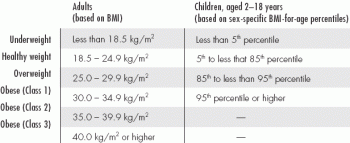
Source: NIH Publication no. 98-4083. Clinical Guidelines on the Identification, Evaluation, and Treatment of Overweight and Obesity in Adults: The Evidence Report. NHLBI (National Heart, Lung, and Blood Institute); 1998.
Experts at the CDC have been reluctant to classify children and teens as obese, suggesting instead that the terms "at-risk of overweight" and "overweight" be used because the ratios reflect measures of weight, not fat. They also raised concerns about possibly labeling children. The Institute of Medicine's (IOM) report "Preventing Childhood Obesity" (2004), however, argues that "childhood obesity" is a stronger term because it conveys a better sense of health risks than does "childhood overweight." BMI, however, is more highly correlated with body fat (National Research Council 1989), and associated with increased risk of hypertension, dyslipidemia, glucose intolerance, type 2 diabetes and arthritis in children and teens. In adults, the BMI cut points of 25 kg/m2 (which is approximately 10% above ideal body weight) and 30 kg/m 2 are based on epidemiologic data showing increasing morbidity (cardiovascular disease, diabetes, cancer, arthritis and disability) and mortality at a BMI greater than 25 kg/m 2, and even greater increases in risk for individuals with a BMI above 30 kg/m 2 (NHLBI, 1998).
Written and revised by
David Cohen, M.D.
Our doctors write and review articles for accuracy and keep them up to date.
health.am provides general information, not medical advice. Always consult a qualified health professional about your own health.
Explore health topics
More in this topic
Weight & Nutrition → News
Traveler's alert: Business travel linked to obesity and poor health
Road warriors who travel for business two weeks or more a month have higher body mass index, higher rates of obesity and poorer self-rated health than those who travel less often, according to researchers at Columbia…
3 May 2011
 News
Kidney disease patient health: Moderate alcohol and calcium help, obesity harms
1. Moderate Drinking Benefits Kidney Transplant Recipients Modest Amounts of Alcohol Prevent Diabetes and Premature Death Moderate alcohol consumption reduces one's risk for diabetes and premature death in the general…
22 November 2010
NewsReport says obesity surgery can save health costs
Providing surgical treatment for people who are morbidly obese could save British taxpayer-funded health services and the wider economy hundreds of millions of pounds a year, leading surgeons said on Wednesday. In an…