US farm subsidy policies contribute to worsening obesity trends
Key points
- Agricultural subsidies are responsible for making those processed and energy-dense foods that contribute to the American epidemic of obesity the most affordable options for consumers, concludes a new study led by Dr.
- "Tackling the policies that translate into food production and availability could be the most widespread preventive measure to address the obesity epidemic," according to Caroline Franck, lead author of the paper published in the American Journal of Preventive Medicine.
- While many factors contribute to obesity, the ready availability and low cost of unhealthy foods in comparison with healthy alternatives are crucial.
- Citing statistics from 2004, the study notes that 96% of American cropland is dominated by eight main crops, including soybean and corn.
Agricultural subsidies are responsible for making those processed and energy-dense foods that contribute to the American epidemic of obesity the most affordable options for consumers, concludes a new study led by Dr. Mark J. Eisenberg, a cardiologist and epidemiologist at the Lady Davis Institute at the Jewish General Hospital in Montreal. As Congress debates a new Farm Bill that will determine agricultural policy for the next five years, it is critical that public health be factored into legislation that will define the country's nutritional environment.
"Tackling the policies that translate into food production and availability could be the most widespread preventive measure to address the obesity epidemic," according to Caroline Franck, lead author of the paper published in the American Journal of Preventive Medicine.
While many factors contribute to obesity, the ready availability and low cost of unhealthy foods in comparison with healthy alternatives are crucial. Indeed, obesity has been closely associated with poverty. Grocery stores and restaurants sell foods made from cheap commodities at lower prices, and commodities used in high fat and sweetened foods are artificially cheap because government subsidies have made the crops used to produce them lucrative to grow.
Citing statistics from 2004, the study notes that 96% of American cropland is dominated by eight main crops, including soybean and corn. The former is the source of 70% of the fats and oils consumed by Americans, while the latter is a high calorie component of soft drinks, fruit drinks, canned fruits, condiments, baked goods, and ice cream, all of which contribute to obesity.
Recognizing that farm subsidies are an important safety net for a volatile industry, Franck and her co-authors propose that agriculture policy take public health into account when identifying how they ought to be dispensed. They recommend investing in sustainable agriculture that emphasizes biodiversity, quality foods, optimizing non-renewable resources, and sustaining the economic viability of farmers. Farmers should be encouraged to grow fruits and vegetables in place of produce used for sweeteners and hydrogenated oils.
"A successful reorganization of the American food environment will require commitment to mutually supportive interventions affecting food availability, price, marketing, and health education, at the local, state, and federal levels of government," Franck wrote. "A revision of agricultural priorities is in order: public health interventions will remain limited in their impact until they can inform decisions that are made at every level of the American food chain, from growers to consumers."
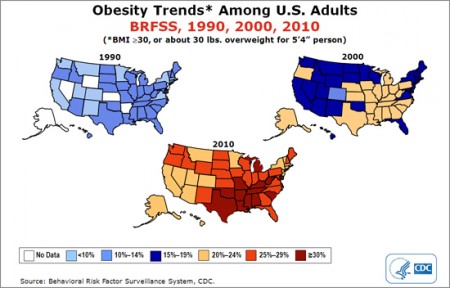
This set of maps, from the U.S. Centers for Disease Control and Prevention, offers a state-by-state look at the tremendous increase in adult obesity over the past two decades. In 1990, no state had an obesity rate higher than 15 percent. By 2010, no state had an obesity rate lower than 20 percent, and 12 states had obesity rates greater than 30 percent.
Written and revised by
Gerald Hurowitz, M.D.
Our doctors write and review articles for accuracy and keep them up to date.
health.am provides general information, not medical advice. Always consult a qualified health professional about your own health.
Explore health topics
More in this topic
Weight & Nutrition → News
Weight and diet may help predict sleep quality
The old adage " you are what you eat ," may be better phrased as " your sleep relates to what you eat ." An individual's body composition and caloric intake can influence time spent in specific sleep stages, according…
12 June 2016
 News
NHS needs to perform more weight loss surgery to curb the obesity epidemic
The NHS should significantly increase rates of weight loss surgery to 50,000 a year, closer to the European average, to bring major health benefits for patients and help reduce healthcare costs in the long term, argue…
12 May 2016
 News
Despite efforts, childhood obesity remains on the rise
The alarming increase in U.S. childhood obesity rates that began nearly 30 years ago continues unabated, with the biggest increases in severe obesity , according to a study led by a Duke Clinical Research Institute…