
Vulnerability, Stress, and Psychiatric Diatheses: A Hypothetical Model
Key points
- Figure 21 depicts an integrative schema that conceptualizes the interplay of extrinsic and intrinsic factors with the schizophrenia diathesis.
- In Figure 21, the vertical axis represents vulnerability to psychotic symptoms of the schizophrenic type and the horizontal axis depicts the proportion of the general population.
- Only a fraction of 1% of the population express a vulnerability so great that a schizophrenic psychosis will emerge under virtually any level of life stress, no matter how minor.
- However, several percent of the population have a meaningful but lesser degree of vulnerability, such that the schizophrenic psychosis will become manifest if a great enough stress is encountered to "push the patient over the brink.
Figure 21 depicts an integrative schema that conceptualizes the interplay of extrinsic and intrinsic factors with the schizophrenia diathesis. The basis for this formulation is the familiar stress-diathesis model of schizophrenia (Nuechterlein and Dawson 1984; Zubin and Spring 1977), supported by more recent understanding of the neuropsychological underpinnings of the pathophysiology of schizophrenia (Weinberger 1987).
In Figure 21, the vertical axis represents vulnerability to psychotic symptoms of the schizophrenic type and the horizontal axis depicts the proportion of the general population. At the far left, a tiny fraction of the population manifests a very high vulnerability to psychosis, with an everdecreasing loading for such risk moving to the right along the curve.
Only a fraction of 1% of the population express a vulnerability so great that a schizophrenic psychosis will emerge under virtually any level of life stress, no matter how minor.
However, several percent of the population have a meaningful but lesser degree of vulnerability, such that the schizophrenic psychosis will become manifest if a great enough stress is encountered to "push the patient over the brink." This stress can come from any of a variety of sources and can be biological, psychological, or social.
{embed="ref/61"}
The model depicted fits much of what we know about schizophrenia and what can influence its expression. If the fundamental vulnerability is genetic, additional biopsychosocial stressors might be poor maternal nutrition (associated with poverty), intrauterine viral infection, injuries during a difficult delivery, inadequate childhood nutrition, lack of normal childhood stimulation, lack of opportunity to learn protective interpersonal and coping skills, developmental experiences promoting intrapsychic conflicts, extreme psychic stress in adolescence/early adulthood (e.g., high "expressed emotion," poverty, trauma, chaotic environments), and the biological, psychological, and social insults that may be associated with substance use and abuse.
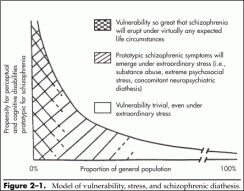
Figure 21. Model of vulnerability, stress, and schizophrenic diathesis.
Integrative schema conceptualizing the interplay of extrinsic and intrinsic factors with the schizophrenic diathesis. Source. Reprinted with permission from Siris SG, Lavin MR: "Schizoaffective Disorder, Schizophreniform Disorder and Acute Psychotic Disorder (Including Brief Reactive Psychosis)," in Comprehensive Textbook of Psychiatry/VI, 6th Edition. Edited by Kaplan HI, Sadock BJ. Philadelphia, PA, Williams & Wilkins, 1995, pp. 1019 1031 (p.
1021). Copyright 1995, Williams & Wilkins.
Once the patient is "pushed over the brink" into psychosis, of course, the full physiological and biopsychosocial cascade of events is unleashed, representing the multivariate clinical course of schizophrenia.
Written and revised by
Andrey Nailor, M.D.
Our doctors write and review articles for accuracy and keep them up to date.
health.am provides general information, not medical advice. Always consult a qualified health professional about your own health.
Explore health topics
More in this topic
Mental Health → News
Psychiatric drug use in preschoolers stabilizing
By the end of the last decade, psychiatric medications were being used less often in very young children, a new study suggests. Researchers found the percentage of children prescribed antipsychotics, stimulants and…
1 October 2013
 News
IU research attributes high rates of smoking among mentally ill to addiction vulnerability
People with mental illness smoke at much higher rates than the overall population. But the popular belief that they are self-medicating is most likely wrong, according to researchers at the Indiana University School of…
28 September 2013
 News
Quit smoking program helps psychiatric patients, too
Patients in psychiatric hospitals who take part in smoking cessation programs during their stay are more likely to be smoke-free after 18 months, compared to patients who don't participate in the programs, says a new…




