
The Addicted Brain
Key points
- Only within the last several decades have we begun to understand why a person will use a substance compulsively, regardless of the consequences, even to the point of death.
- As addiction has been studied in the past couple of decades, we have found that alcohol and every major class of drugs of abuse interact with the same part of the brain in one fashion or another.
- The key to understanding this puzzling behavior lies in a series of discoveries made over the last forty years.
- In the 1960s researchers began to find receptors in the brain for opiate-like substances.
Only within the last several decades have we begun to understand why a person will use a substance compulsively, regardless of the consequences, even to the point of death.
The key to understanding this puzzling behavior lies in a series of discoveries made over the last forty years. In the 1950s it was learned that if a certain part of the brain is electrically stimulated, an intensely pleasurable sensation occurs.
In the 1960s researchers began to find receptors in the brain for opiate-like substances. Later in that decade the discovery was made that the brain produces opiate-like substances (endorphins), which explained the presence of the opiate receptors.
The Pleasure Center
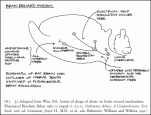
As addiction has been studied in the past couple of decades, we have found that alcohol and every major class of drugs of abuse interact with the same part of the brain in one fashion or another. This part of the brain is the same one that produces the intensely pleasurable reaction to electrical stimulation that was noted in the 1950s. It is located in the lower central portion of the brain, the part that regulates automatic functions such as breathing and appetite. It is connected to the relay centers of the brain that include the thalamus and hypothalamus, as well as to higher parts of the brain such as the cortex, where most of our learning and reasoning take place. This part of the brain is called the ventral tegmentum and is part of a circuit known as the medial forebrain bundle.
It includes tracts of nerve cells called the mesolimbic tracts.
The primary purpose of this part of the brain seems to be to produce a pleasurable sensation when it is stimulated and to make sure that the higher parts of the brain remember what the stimulation was so that it will be repeated. This area is intertwined with parts important in memory and learning and with those which control appetite and sexual desire (fig. 3.1).
The cells that make up this area are rich in the same neurotransmitters (see below) which regulate emotion, and their fibers extend to and interact with the structure of the brain that mediates emotional tone (the limbic system).
It has been consistently demonstrated that drugs with addictive properties are active in the ventral tegmentum. In fact, one way in which researchers study addictive drugs is to stimulate that area in the brain of an animal and then observe its behavior. If the animal is hooked up to electrodes that it can learn to stimulate by pressing a lever, it will press that lever over and over - even in lieu of food - until it falls out in exhaustion. A researcher who hooks the animal up to a tiny infusing device that delivers a drug can see whether the animal pushes the lever in the same manner.
Written and revised by
Andrey Nailor, M.D.
Our doctors write and review articles for accuracy and keep them up to date.
health.am provides general information, not medical advice. Always consult a qualified health professional about your own health.
Explore health topics
More in this topic
Mental Health → News
How physical exercise protects the brain from stress-induced depression
Physical exercise has many beneficial effects on human health, including the protection from stress-induced depression. However, until now the mechanisms that mediate this protective effect have been unknown. In a new…
2 April 2015
 News
Brain networks differ among those with severe schizophrenia, CAMH study shows
People with a severe form of schizophrenia have major differences in their brain networks compared to others with schizophrenia, bipolar disorder and healthy individuals, a new study from the Centre for Addiction and…
19 March 2015
 News
People with anorexia and body dysmorphic disorder have similar brain anomalies
People with anorexia nervosa and with body dysmorphic disorder have similar abnormalities in their brains that affect their ability to process visual information, a new UCLA study reveals. People with anorexia have such…





