
Symptom Categories
Key points
- Schizophrenia is a disease that does not discriminate based on race, culture, social status, or gender.
- His bizarre behaviors began in high school, with his first psychiatric hospitalization soon following.
- There are three categories of schizophrenic symptoms: positive, negative, and disorganized.
- In simple terms, a positive symptom signals a behavior that shouldn't be there.
Schizophrenia is a disease that does not discriminate based on race, culture, social status, or gender. Anywhere in the world, in every culture, one person out of every hundred suffers from schizophrenia. Signs of schizophrenia may emerge in people as young as 15 or as late as one's forties, but it is most common for true psychotic symptoms to reveal themselves in the late teens and early twenties. Indeed, Emilio appears to follow this pattern.
His bizarre behaviors began in high school, with his first psychiatric hospitalization soon following. Interestingly, men seem to develop schizophrenia at an earlier age than women. The average age of onset of schizophrenia in men is 25 years, whereas 29 is the average age for women. Certain traits, such as having a relative with schizophrenia, increase a person's risk of developing the disease. We will discuss risk factors for schizophrenia in another section.
There are three categories of schizophrenic symptoms: positive, negative, and disorganized. Dr. E. Fuller Torrey, in his book Surviving Schizophrenia, explained that the adjective positive "... denotes those symptoms which are present and should be absent."
In simple terms, a positive symptom signals a behavior that shouldn't be there. Remember that positive as used here does not mean "good." An example of a positive symptom is hallucination. Hallucinations occur when someone hears, sees, smells, or feels things that are not really there. Emilio is hearing voices and although we do not know what they are saying, they seem to be contributing to his erratic behavior.
Another positive symptom is delusion. Delusions cause the patient to believe that people are reading their thoughts or plotting against them, that others are secretly monitoring and threatening them, or that they can control other people's minds.
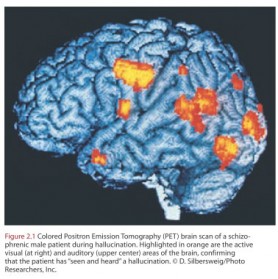
Figure 2.1 Colored Positron Emission Tomography (PET) brain scan of a schizophrenic male patient during hallucination. Highlighted in orange are the active visual (at right) and auditory (upper center) areas of the brain, confirming that the patient has "seen and heard" a hallucination.
In simple terms, a positive symptom signals a behavior that shouldn't be there. Remember that positive as used here does not mean "good." An example of a positive symptom is hallucination. Hallucinations occur when someone hears, sees, smells, or feels things that are not really there. Emilio is hearing voices and although we do not know what they are saying, they seem to be contributing to his erratic behavior.
Another positive symptom is delusion. Delusions cause the patient to believe that people are reading their thoughts or plotting against them, that others are secretly monitoring and threatening them, or that they can control other people's minds.
Written and revised by
David Cohen, M.D.
Our doctors write and review articles for accuracy and keep them up to date.
health.am provides general information, not medical advice. Always consult a qualified health professional about your own health.
Explore health topics
More in this topic
Mental Health → News
Accelerated resolution therapy significantly reduces PTSD symptoms, researchers report
Researchers at the University of South Florida (USF) College of Nursing have shown that brief treatments with Accelerated Resolution Therapy (ART) substantially reduce symptoms associated with post-traumatic stress…
28 July 2012
 News
Improvements in autism symptoms vary kid by kid
A new study suggests that social and communication skills in some kids with autism may improve over time with therapy, but other kids will continue having problems functioning as they get older. Not surprisingly, kids…
3 April 2012
 News
Gladstone scientist finds new target for treating symptoms of Parkinson's disease
A scientist at the Gladstone Institutes has identified how the lack of a brain chemical known as dopamine can rewire the interaction between two groups of brain cells and lead to symptoms of Parkinson's disease. This…





