
Psychopharmacology of Weight Gain
Key points
- Novel antipsychotic medications and conventional antipsychotic medications affect a number of central neurotransmitter systems that may have an impact on satiety and feeding behavior.
- For example, all antipsychotic medications block dopamine D2 and noradrenergic 1 receptors, the same sites stimulated by amphetamines and sympathomimetic amine drugs used to promote weight loss.
- Since the advent of clozapine, novel antipsychotics have been designed primarily to be both relatively weak D2 antagonists and potent antagonists at 5-HT2A receptors, yet these agents also have substantial affinity for the closely related 5-HT2C receptor.
- 1992), but data implicate antagonism of 5-HT2C receptors as a possible site where novel antipsychotics might have an impact on weight (Tecott et al.
Novel antipsychotic medications and conventional antipsychotic medications affect a number of central neurotransmitter systems that may have an impact on satiety and feeding behavior. Many of the receptor systems blocked by antipsychotic medications are those that are stimulated by medications that promote weight loss.
For example, all antipsychotic medications block dopamine D2 and noradrenergic 1 receptors, the same sites stimulated by amphetamines and sympathomimetic amine drugs used to promote weight loss. Additionally, psychotropic drugs influence serotonin (5-HT) and histamine H1 neurotransmission, both of which have been reported to affect food intake and cause fluctuations in weight. In examining the binding profiles of antipsychotic agents, the receptor affinity characteristic most closely correlated with weight gain among novel antipsychotic medications was H1 antagonism (Wirshing et al. 1999) (see Figure 31). Although H1 blockade also causes sedation, the mechanism by which H1 receptor antagonism may increase weight is peripheral interference with normal satiety signals from the gut, resulting in overeating (Knight 1985; Rockwell et al. 1983).
Both low-potency conventional agents and those novel antipsychotic medications with higher weight gain potential have substantial affinity for this receptor (Schotte et al. 1993); however, what may contribute to the greater weight gain seen with some of the novel antipsychotics is the additional effect of 5-HT2C antagonism. Since the advent of clozapine, novel antipsychotics have been designed primarily to be both relatively weak D2 antagonists and potent antagonists at 5-HT2A receptors, yet these agents also have substantial affinity for the closely related 5-HT2C receptor.
It is known that compounds that stimulate 5-HT transmission reduce food consumption and cause weight loss (e.g., m-chlorphenylpiperazine, fenfluramine, sibutramine) whereas drugs that decrease 5-HT transmission increase food intake and are associated with weight gain (Goodall et al. 1988; Samanin and Garattini 1990). It is unclear which 5-HT receptor type is responsible for stimulating food intake and weight gain (Aulakh et al. 1992), but data implicate antagonism of 5-HT2C receptors as a possible site where novel antipsychotics might have an impact on weight (Tecott et al. 1995).
{embed="ref/57"}
Evidence for this assertion comes from two types of data. Drugs such as fenfluramine are thought to suppress appetite via 5-HT2C agonism (Garattini et al. 1989); moreover, Tecott and colleagues developed a strain of mice in which the gene coding for the 5-HT2C receptor was knocked out.
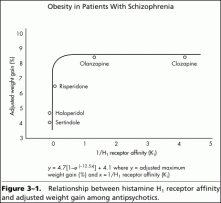
Figure 31. Relationship between histamine H1 receptor affinity and adjusted weight gain among antipsychotics.. Reprinted from Wirshing D, Wirshing W, Kysar L, et al.: "Novel Antipsychotics: Comparison of Weight Gain Liabilities." Journal of Clinical Psychiatry 60:358363, 1999. Used with permission.
Written and revised by
Andrey Nailor, M.D.
Our doctors write and review articles for accuracy and keep them up to date.
health.am provides general information, not medical advice. Always consult a qualified health professional about your own health.
Explore health topics
More in this topic
Mental Health → News
Earlier bedtimes may help protect adolescents against depression and suicidal thoughts
A study in the Jan. 1 issue of the journal Sleep found that adolescents with bedtimes that were set earlier by parents were significantly less likely to suffer from depression and to think about committing suicide,…
4 January 2010
 News
Overweight Kids Experience More Loneliness, Anxiety, MU Study Finds
As childhood obesity rates continue to increase, experts agree that more information is needed about the implications of being overweight as a step toward reversing current trends. Now, a new University of Missouri…
3 July 2009
 Guide
Rational Psychopharmacology for People With HIV/ HCV and Schizophrenia
HIV-related psychopharmacological interventions for people with preexisting schizophrenia follow similar guidelines for patients with new-onset psychosis associated with HIV infection. In advanced HIV infection,…






