Psychoeducational programs for teaching safe sex
Key points
- During the past two decades, a relatively small number of sexual education programs designed for mentally disabled persons have been described in the literature.
- At the UCLA Neuropsychiatric Hospital and Behavioral Health Service, an eight-session sex education course was devised and offered by the Aftercare Clinic, a program devoted to young persons within 2 years of the onset of their schizophrenia.
- The exercises were an excellent means of "warming up" the group to facilitate the sharing of experiences and exploration of attitudes.
- a Associate Professor of Psychiatry, David Geffen School of Medicine at UCLA bProfessor of psychiatry at the University of California at Los Angeles cDepartment of Psychiatry, University of California, Los Angeles,.
During the past two decades, a relatively small number of sexual education programs designed for mentally disabled persons have been described in the literature. They have almost exclusively focused on safe sex, not on helping patients to learn about the process of considering and deciding whether or not to have sexual relations. Nor have these programs taught patients how to go about having mutually satisfying sex with a partner. Extant educational programs primarily have been discussion groups. Typically the discussion leader follows an outline and distributes printed handouts for patients to read and refer to in the future.
Given the problems with verbal learning and memory, "talk groups" and printed assignments go about as far as the next hour in the mind/brain processing of persons with schizophrenia. Nonetheless, programs have been presented that touch on increasing patients' knowledge and comfort about sexual physiology, identifying and clarifying values and attitudes about sexuality, overcoming medication-related sexual dysfunctions, and basic HIV education and proper condom use. In some programs, graphics have been emphasized to compensate for the cognitive impairments of individuals with schizophrenia.
One such program, Choices: An AIDS Prevention Curriculum, is a program for high-risk, seriously mentally ill persons subject to sexual exploitation and ignorance about sexual practices. Designed to be taught to small groups in four 1-hour sessions, Choices follows a psychosocial education model guided by the emotional and attentional responsiveness of the patients. This educational package presents information and encourages discussion and learning through multimedia sources: videos and audiotapes, illustrations and photographs, printed brochures, games, role plays, quizzes, and problemsolving and question-and-answer segments. Extensive experience in outpatient, inpatient, and residential settings has shown Choices to be effective, tolerable, and enjoyable for a wide variety of patients.
Sex Education Course for Young Adults with Schizophrenia at UCLA
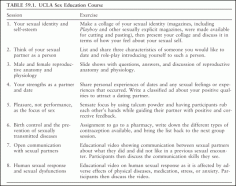
At the UCLA Neuropsychiatric Hospital and Behavioral Health Service, an eight-session sex education course was devised and offered by the Aftercare Clinic, a program devoted to young persons within 2 years of the onset of their schizophrenia. The aims of the course were to help participants gain more knowledge and comfort about their own sexuality and that of others; to identify and clarify their values and attitudes about sexuality; and to acquire decision-making skills regarding sexual relations. The curriculum of the course is presented in Table 59.1.
{embed="ref/stat-menu-schizophrenia2"}
When the course was first proposed to the interdisciplinary mental health staff at a team meeting of the Clinic, there was a collective "gulp and gasp" at the explicitness of the material and format. The team members described discomfort at having patients discuss topics such as their previous sexual experiences, number of partners, and sexual dysfunction. In contrast, the course leaders did not discern discomfort among the patients in open discussion of these topics. As would be expected with low assertive and socially withdrawn young persons with schizophrenia, active verbal participation had to be specifically elicited during the group meetings.
Written and revised by
David Cohen, M.D.
Our doctors write and review articles for accuracy and keep them up to date.
health.am provides general information, not medical advice. Always consult a qualified health professional about your own health.
Explore health topics
More in this topic
Mental Health → Guide
Celexa use in pregnancy relatively safe: study
The antidepressant citalopram (Celexa) may be used cautiously in pregnant women, according to a report from Canada. The researchers report no excess birth defect risk, although an increased risk of "poor neonatal…
17 December 2005
 News
ADHD Researcher Helping Japan Implement Programs
A leading ADHD researcher from the University at Buffalo is consulting with mental-health experts and physicians in Japan who are developing the first programs for children with attention deficit hyperactivity disorder…
30 November 2005
 News
Doctors' group says antidepressants safe for teens
A new report from the American Medical Association's Council on Scientific Affairs (CSA) suggests that antidepressants - including so-called SSSRIs such as Prozac - are appropriate therapies for the treatment of…