Andrey Nailor, M.D.·Published 5 January 2011·11 min read
Key points
Although few psychiatric rehabilitation programs have comprehensively addressed the friendship and intimacy needs of seriously mentally ill persons, the studies conducted to date have demonstrated the feasibility of their use and participants' enthusiasm for the subject matter.
Developing the curricula to teach friendship and intimacy skills is neither quick noreasy.
a Associate Professor of Psychiatry, David Geffen School of Medicine at UCLA bProfessor of psychiatry at the University of California at Los Angeles cDepartment of Psychiatry, University of California, Los Angeles,.
Perhaps another contributing factor is that deficiencies in vital areas of social functioning of many individuals with serious mental illness potentially obscure from the clinician's view the importance of their sexuality.
Although few psychiatric rehabilitation programs have comprehensively addressed the friendship and intimacy needs of seriously mentally ill persons, the studies conducted to date have demonstrated the feasibility of their use and participants' enthusiasm for the subject matter. Given the apparent need for this type of material, practitioners' difficulties with expressing sexual material cannot fully explain the relative rarity of such programs.
Perhaps another contributing factor is that deficiencies in vital areas of social functioning of many individuals with serious mental illness potentially obscure from the clinician's view the importance of their sexuality.
It is not surprising, therefore, that sexuality issues frequently arise in the context of social skills training, because this modality is geared toward eliciting the goals and desires of participants. As such, skills training technology is a place to start when constructing a program to provide explicit instructions to individuals with serious mental illness in the realms of friendship, dating, intimacy, and sexuality.
Skills training closes the gap between the individual's current skills and those needed for improved functioning.
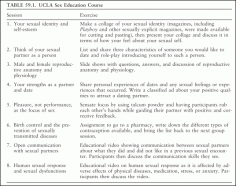
TABLE 59.1. UCLA Sex Education Course
The methods used to teach friendship, and safe and satisfying sex are based on motivational enhancement and behavioral learning principles:
Ensure that patients "buy into" the module through identifying its relevance to their own personal goals.
Understand the benefits to patients of learning the skills from a personal frame of relevance.
Specify the know-how and skills to be trained; check for understanding.
Demonstrate the skills. Learn by watching videotaped models and answering patients' questions to ensure that they have internalized the skills.
Have patients practice the skills until they can perform them competently. Provide abundant positive reinforcement for patients who approximate criteria of competence.
Teach patients to employ the skills in everyday life and gain reinforcement from the group, the trainer, and people in the natural environment.
{embed="ref/stat-menu-schizophrenia2"}
Developing the curricula to teach friendship and intimacy skills is neither quick noreasy. Moreover, the instructional techniques must compensate for individuals' cognitive dysfunctions that might interfere with learning. Liberman and colleagues (1993) addressed this difficulty by producing a series of eight "modules" that teach community living skills with thoroughly specified curricula and highly structured training steps: Medication Self-Management, Symptom Self-Management, Substance Abuse Management, Recreation for Leisure, Basic Conversation, Workplace Fundamentals, Community Reentry and, most recently, Friendship and Intimacy. All use the same behavioral learning activities and problem-solving exercises to train each skill in each module. Only the content varies among modules, and the repetition of the learning activities provides a predictable teaching environment that enables trainers to conduct the modules and individuals to acquire the skills.
Written and revised by
Andrey Nailor, M.D.
Our doctors write and review articles for accuracy and keep them up to date.
health.am provides general information, not medical advice. Always consult a qualified health professional about your own health.
The Friendship and Intimacy module uses a plot line that follows a couple whose relationship develops from friendship and dating to the considerations and problem solving regarding the pros and cons of engaging in sex. In the context of a maturing relationship, the partners demonstrate appropriate communication skills with each other, with trusted friends and relatives, and with health care professionals. After evaluating their relationship and how it might change if they engaged in sexual intimacy, they decide gradually to engage in physical affection and ultimately sexual intercourse.
{pagebreak}
It is important to note that the latter skills areas of the module contains sexually explicit material, thus requiring trainers to obtain essential education and supervision as a means of becoming confident, assertive, and comfortable in discussing intimate sexual matters with patients. The earlier skills areas are organized in one videocassette, trainer's manual, and participants' workbook, whereas the more sexually explicit skills areas that teach how to engage in mutually satisfying sex are presented as a second volume, with its own videocassette, trainer's manual, and participants' workbook. Thus, it is possible to use the initial volume to teach dating and friendship skills, safe sex, and how to consider the advantages and disadvantages of having sexual relations, without including the more physically explicit skills areas that teach participants how to have satisfying sex and overcome sexual problems.
In Skills Area 1, Establishing a Friendship, the focus is on teaching participants how to begin friendships. Participants learn how to meet people with similar interests, while practicing and polishing their conversational skills. They are taught how to express feelings about the importance of a relationship, and how to ask someone out on a date. Skills Area 1 ends with a demonstration of a typical date, including how to begin, maintain, and end a conversation. There are also scenes that present problems depicting awkward moments in conversations on a date and the dilemma of whether or not to kiss a date goodnight.
Skills Area 2, Obtaining Information about Safe Sex, introduces the participant to some basic information about sexuality. This skills area includes four vignettes that focus on conception, contraception, sexual desire, and sexually transmitted diseases. In the first vignette, the main characters, Jim and Katie, visit a physician to elicit the information they need prior to including sex in their relationship. The next vignette features three young people, like the main characters, who have their own discussion about contraception and the notion of shared responsibility between partners in a loving relationship.
{embed="ref/stat-menu-schizophrenia2"}
This second vignette reinforces the use of contraception as the means of avoiding unwanted pregnancy and maintaining good health. Abstinence from sex is also included as a viable option.
The third and fourth vignettes in Skills Area 2 demonstrate how the knowledge presented earlier can be used in a practical and realistic situation. In the third vignette, Jim goes to a pharmacy to purchase condoms. A pharmacist reminds him why condoms are recommended: "to prevent pregnancy and to avoid sexually transmitted diseases." In the fourth vignette, the scene is repeated, except that Katie goes by herself to the pharmacy to purchase condoms.
Skills Area 3, Identifying the Benefits and Risks of Having Sex, follows the protagonists as they discuss the consequences of including or not including sex in a relationship.
These conversations elaborate on both the positive and negative aspects of the physical, financial, familial, employment, relationship, and emotional consequences of engaging in sexual behavior. Sexual decision making is demonstrated in seven vignettes, including conversations between two male friends, two female friends, Jim and Katie (a couple in a serious relationship), and between Jim and Katie and a second couple with a young child.
This final vignette places sexual decision making in a real-life context as unmarried partners discuss the consequences of having a child whom they both love, but who was not planned. The parents discuss, and at times argue about, the pressures they face. From losing sleep, having to take a second job, and lack of support from the baby's grandparents, to relapse of psychiatric symptoms and increased alcohol use by one of the parents, both acknowledge that "having sex just one time without a condom" can have significant adverse consequences.
Skills Area 4, Sharing Concerns, Consequences, and Cautions about Sexuality, introduces the very contemporary and vitally important topic of giving one's own history and eliciting a sexual history from a partner. Jim and Katie exchange information about their previous sexual contacts. Emphasis is placed on self-disclosure, particularly with respect to past and current partners, and the recognition that one cannot safely assume the absence of sexually transmitted disease because of a current lack of symptoms. Jim and Katie acknowledge that they are both willing to be tested for sexually transmitted diseases and agree to make their relationship monogamous.
Skills Area 5, Sexual Decision Making, uses nine brief interactions between Jim and Katie to introduce an essential set of communication skills. These so-called "go/no-go" signals include the subtle and not so subtle cues that people use to indicate interest in a two-way conversation or an exchange of information. Go/no-go signals are used by the partners to communicate a lack of interest in pursuing sexual activity or to reinforce a partner's sexual advances. Acquiring the skill to accurately read a partner's go/no-go signals is a prerequisite to good communication and to achieving a satisfying sexual relationship.
{pagebreak}
By this point in the plot, Jim and Katie have made a well-reasoned decision about having sex, they have been tested for sexually transmitted diseases, and they have a supply of condoms. Thus, they proceed to the next step. In Skills Area 6, Learning Appropriate Sexual Behavior, a range of sexual behaviors is modeled, including appropriate touching, communication skills preceding sexual relationships (e.g., asking permission), and communication skills while engaged in a sexual encounter (e.g., attending to the needs of one's partner). Limit setting and respectful compliance are demonstrated in the opening vignette. The vignettes that follow all include full nudity.
To desensitize viewers' to the discomfort caused by the explicit nature of their behavior, Katie and Jim are first seen nude individually, each at his or her own apartments, preparing for the date that will culminate in their first sexual encounter. In the next few vignettes, explicit sexual behavior, including intercourse, is graphically depicted. Jim and Katie meet in their friend's apartment. They acknowledge both their eagerness for sexual intercourse and their nervousness about adding that new dimension to their relationship.
Safe and appropriate use of a condom and spermicidal jelly is modeled as this series of vignettes is concluded. The final vignette of this skills area focuses on Jim and Katie after their sexual relationship has matured for a few months. They acknowledge their initial awkwardness and the importance of communicating their sexual needs. This skills area closes with a sexual encounter that "puts it all together" as Jim and Katie demonstrate the skills they have learned. The component skills (giving and receiving permission, assertive requests, guided hands) are combined into a free flowing, loving, and tender sexual encounter.
{embed="ref/stat-menu-schizophrenia2"}
Skills Area 7, Communication Skills after Sexual Intercourse, involves two brief vignettes. In both, Jim and Katie engage in appropriate verbal and nonverbal communication after they have had intercourse. They mutually reinforce each other for their decision making, for being able to give specific instructions about how they like to be touched, and for pleasing each other.
Skills Area 8, Sexual Problems: Desire, Arousal, and Orgasm, uses a number of vignettes to present common problems related to the phases of sexual response, namely, desire, arousal, and orgasm. The purpose for including this section is to provide education about sexual functioning; to normalize problems of desire, arousal, and orgasm; and to teach effective problem-solving methods when sexual dysfunctions occur. Vignettes include scenes of Jim and Katie talking with their respective male and female friends/confidants, and Jim and Katie alone.
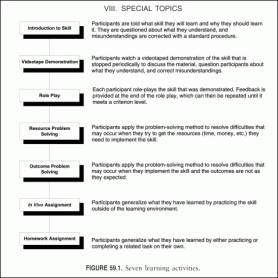
The training methodology comprises the seven learning activities detailed in Figure 59.1. The introduction sets the stage for the learning; it tells the learners the "payoff" they can expect from their investment of time and energy. The demonstration videotape provides a clear presentation of the skills that can be easily and consistently presented across diverse staff and settings. The videotape's periodic stops and the questions to assess viewers' comprehension are essential to ensure that the training achieves its instructional objectives. The role-play practice is similarly critical, because learning is not just comprehension; it is ultimately the enactment of a skill. Furthermore, the more often participants practice enacting the skill, the more polished their performances when the actual opportunities arise.
FIGURE 59.1. Seven learning activities.
The problem-solving activities are the first steps in helping participants to transfer their skills to their natural, living environments. Two types of problems are considered: how to obtain the resources required to perform a skill, and how to overcome the obstacles inherent in situations and environments when others do not respond as expected.
{pagebreak}
The final two activities-in vivo and homework assignments-extend training into the real world. Participants complete the in vivo assignments accompanied by a trainer or support person. Once they demonstrate their facility in using the skills in a protected environment, they are asked to complete homework assignments on their own. The sequences of gradually learning more skills, success using the skills, and taking more responsibility for reaching personal goals combine to move the patient further along the pathway to empowerment, self-efficacy, and recovery.
Each module is packaged with a trainer's manual, participant's workbook, and demonstration videotape. The manual specifies exactly what the trainer is to say and do to teach all of a module's skills; the videotape demonstrates the skills; and the workbook provides written material, forms, and exercises that help the individual learn the skills. A module can be easily conducted by one trainer with one to eight participants. More than eight, however, reduces the opportunities for each participant to answer the questions, and practice the skills and the problem-solving exercises. Therefore, larger groups require a cotherapist or cotrainer. This module can also be used effectively and for a briefer time with individuals or couples.
{embed="ref/stat-menu-schizophrenia2"}
Of course, the teaching must be modified to fit and to compensate for the large variations in people's functioning, symptoms, and capabilities to benefit from training. The modules' repetitive, "tight" structures provide a completely reproducible starting point for these modifications. Experienced trainers can experiment with a variety of alterations, and inexperienced trainers can return to the structure should their modifications prove ineffective. The repetitive structure and social learning principles intrinsic to the modules compensate for most symptomatic and cognitive limitations, and form a constant background of psychosocial treatment against which the effects of other treatments (e.g., medications) can be determined.
###
Alex Kopelowicz, M.D.a Robert Paul Libermanb Donald Stolar, PhDc
a Associate Professor of Psychiatry, David Geffen School of Medicine at UCLA bProfessor of psychiatry at the University of California at Los Angeles cDepartment of Psychiatry, University of California, Los Angeles,. Los Angeles, California
###
REFERENCES
Assalian, P., Fraser, R. R., Tempier, R., & Cohen, D. (2000). Sexuality and quality of life of patients with schizophrenia. International Journal of Psychiatry in Clinical Practice, 4, 29–33.
Coverdale, J. H., & Turbott, S. H. (2000). Risk behaviors for sexually transmitted infections among men with mental disorders. Psychiatric Services, 51, 234–238.
Crenshaw, T. L., & Goldberg, J. P. (1996). Sexual pharmacology: Drugs that affect sexual functioning. New York: Norton.
Friedman, S., & Harrison, G. (1984). Sexual histories, attitudes and behavior of schizophrenic and "normal" women. Archives of Sexual Behavior, 13, 555–567.
Goisman, R. (2001). Choices: An educational program for AIDS prevention. Boston: MMH Reseach Corporation.

 News
 News
 News