Discussing Bone Health
Key points
- Young people who develop anorexia before reaching their genetically programmed adult height may end up shorter than they would be if they were nutritionally healthy.
- If your daughter's anorexia begins prior to or early in puberty, her first menstrual period and the development of other features of sexual maturity will likely be delayed.
- Amenorrhea and low estrogen set the stage for bone loss, a condition known as osteopenia, which can develop early in the course of anorexia and advance to the more serious condition of osteoporosis.
- Bone loss occurs in many boys with anorexia as well.
Healthy puberty brings about a growth spurt. Young people who develop anorexia before reaching their genetically programmed adult height may end up shorter than they would be if they were nutritionally healthy. Boys grow for about two years longer than girls and thus are more prone to shortened stature as a result of anorexia. Through improved nutrition, these individuals are often able to make up for some of their lost growth, but they may never reach their full height potential. Semistarvation disturbs the body's hormone system. A hallmark of anorexia nervosa, amenorrhea (the absence of menstrual periods) stems from a combination of poor nutrition, reduced body fat, overexercise, low weight, and emotional stress. Insufficient body fat, in particular, is an important reason why girls with anorexia nervosa do not get their periods.
If your daughter's anorexia begins prior to or early in puberty, her first menstrual period and the development of other features of sexual maturity will likely be delayed. If she falls prey to anorexia after menarche (first menses), she will find that her monthly cycles become irregular or stop.
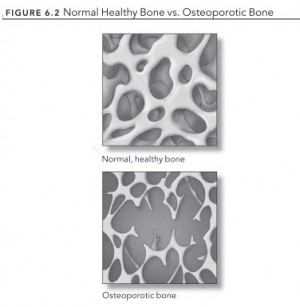
Amenorrhea and low estrogen set the stage for bone loss, a condition known as osteopenia, which can develop early in the course of anorexia and advance to the more serious condition of osteoporosis. More than 90 percent of women and 50 percent of teenage girls with anorexia sustain some loss in bone density. As a result, their bones become fragile, weak, and particularly susceptible to fracture. Due to a combination of bone loss and inadequate bone formation, people who develop anorexia during adolescence are more vulnerable to osteoporosis than those who develop the eating disorder later in life.
Bone loss occurs in many boys with anorexia as well. The good news is that advances in x-ray technology have made it possible to detect bone loss (or risk thereof ) in its early stages. Painless, noninvasive, and with minimal radiation, a bone density test (also known as densitometry) measures the amount of mineral in a bone. The skeletal areas most often tested are the lower spine (lumbar vertebrae) and the hips. Higher density bones are stronger and more resistant to breakage than lower density ones. Looking back on her initial bone density study, Anita notes, "It was really easy and fast. Less than a year after the first test, my doctor recommended a second one to see if there were any changes." The suggested interval of not more than a year between a first and second bone density scan is particularly important in the teenage years, which represent a key period of growth. Bone formation is greatest between the ages of 11 and 14 in girls and 13 and 16 in boys. Ninety percent of a person's total bone mass has developed by late adolescence or early adulthood.
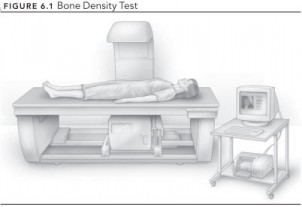
FIGURE 6.1 Bone Density Test
For a girl to bring back her periods, she needs to regain weight, with a healthy proportion of it consisting of fat. The patient with anorexia who overexercises is often very anxious about putting on pounds in the form of fat. She may regain the suggested amount of weight, but because not enough of it is fat, a delay in the return of her periods is possible. It is not unusual for an individual to perceive thinness as more important than the restart of her menses, especially if she competes in a sport that ties weight to performance. If your daughter is reluctant to put on fat, you need to be patient, realizing how emotionally charged this topic is for her.
Written and revised by
Andrey Nailor, M.D.
Our doctors write and review articles for accuracy and keep them up to date.
health.am provides general information, not medical advice. Always consult a qualified health professional about your own health.
Explore health topics
More in this topic
Mental Health → News
E-cigarettes and mental health
Researchers at University of California, San Diego School of Medicine report that people living with depression, anxiety or other mental health conditions are twice as likely to have tried e-cigarettes and three times…
13 May 2014
NewsAnimal hoarding, a lesser-known problem for public health and welfare
This is the first study in Europe on the mental disorder popularly known as animal hoarding Animal hoarding is a psychiatric disorder that consists of accumulating large numbers of animals at home, usually cats and…
6 May 2014
 News
Abuse jeopardizes new mothers' mental health
Ashley Pritchard, a Simon Fraser University doctoral student, is among four authors of a new research paper calling for closer monitoring of new mothers for mental health problems in light of their findings. The four…
29 April 2014