Diagnostic Criteria
Key points
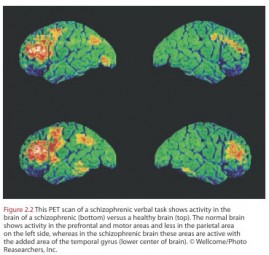
- All the behaviors you just read about may be symptoms of schizophrenia, although very few patients with schizophrenia exhibit all these symptoms.
- A delusion is a false belief that cannot be explained by one's culture or social environment.
- A delusion of grandeur is one in which the person believes that he or she is someone famous or very important such as God or a movie star.
- Alternatively, patients with this kind of delusion might believe that they are especially close to a celebrity or religious figure.
All the behaviors you just read about may be symptoms of schizophrenia, although very few patients with schizophrenia exhibit all these symptoms. Instead, most individuals with the disease display a few of these symptoms. The set of symptoms a patient with schizophrenia experiences is called a symptom profile. In order to diagnose someone with schizophrenia, a clinician must determine that the person has exhibited at least two psychotic symptoms for at least six months. This does not mean that the psychotic symptoms must be continually present for six months, but rather that the symptoms have been present more often than not. A brief discussion of each of the five psychotic symptoms follows:
Delusions. A delusion is a false belief that cannot be explained by one's culture or social environment. Someone with a delusion cannot be dissuaded from this belief, despite evidence that it is not consistent with societal norms.
There are several types of delusions. A delusion of grandeur is one in which the person believes that he or she is someone famous or very important such as God or a movie star.
Alternatively, patients with this kind of delusion might believe that they are especially close to a celebrity or religious figure. Some patients have delusions of guilt in which they believe that they have committed a terrible crime or sin. Someone with schizophrenia might have a somatic delusion in which he or she believes that something terrible has happened to his or her body.
For example, some people with schizophrenia believe they have developed cancer or that their intestines have been replaced with a garden hose. Perhaps the most common kind of delusion is a persecutory delusion.
A person with a persecutory delusion believes that someone or something is trying to hurt him or her. A delusion of reference causes patients to believe that they are being talked about, sometimes on the television or radio, or in the newspaper.
Finally, some patients with schizophrenia experience delusions of thought control, in which they believe that thoughts are being put into or taken out of their minds.
Hallucinations. Hallucinations occur when someone perceives something that others cannot perceive. The most common form of hallucination is auditory, which involves hearing things others can't hear.
Additionally, hallucinations may be visual, in which people believe they see something that no one else can see. Tactile hallucinations occur when an individual feels something that he or she can't explain, like the tingling of electricity for no reason. Rarely, schizophrenia patients experience olfactory hallucinations and smell things that other people cannot smell. Finally, few patients experience gustatory hallucinations and taste things that other people can't taste. The content of gustatory and olfactory hallucinations is usually unpleasant, like the smell or taste of garbage or something rotting.
Written and revised by
Andrey Nailor, M.D.
Our doctors write and review articles for accuracy and keep them up to date.
health.am provides general information, not medical advice. Always consult a qualified health professional about your own health.
Explore health topics
More in this topic
Mental Health → News
Post-traumatic stress disorder seen in many adults living with congenital heart disease
Adults living with congenital heart disease (CHD) may have a significantly higher risk of post-traumatic stress disorder (PTSD) than people in the general population. A single-center study from The Children's Hospital…
17 March 2016
 News
ADHD medications associated with diminished bone health in kids
Children and adolescents who take medication for attention-deficit hyperactivity disorder (ADHD) show decreased bone density, according to a large cross-sectional study presented today at the 2016 Annual Meeting of the…
5 March 2016
 News
Antidepressant may improve cognitive symptoms in people with HIV
In a small, placebo-controlled clinical trial, Johns Hopkins physicians report that the antidepressant paroxetine modestly improves decision-making and reaction time, and suppresses inflammation in people with…