
Children of Britain lead the world in drinking and drugs
Key points
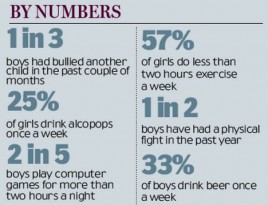
- Children in England drink more alcohol and take more drugs than their counterparts in most of the Western world.
- A report from the World Health Organisation shows that English schoolchildren are among the most likely to have drunk alcohol in the past week, to have taken cannabis and to have had sex.
- Eleven and 13 year olds are among the most likely to have smoked a cigarette.
- And they are more stressed at school than any country except Portugal, mirroring a Unicef study last year which found British children were the most unhappy in Europe.
Children in England drink more alcohol and take more drugs than their counterparts in most of the Western world.
A report from the World Health Organisation shows that English schoolchildren are among the most likely to have drunk alcohol in the past week, to have taken cannabis and to have had sex.
Eleven and 13 year olds are among the most likely to have smoked a cigarette.
And they are more stressed at school than any country except Portugal, mirroring a Unicef study last year which found British children were the most unhappy in Europe.
The report, the Health Behaviour in School-Aged Children, paints a bleak picture of a childhood blighted by pressure to fit in with peer groups and perform well in tests.
The damning report shows that Welsh 13-year- olds are more likely than those in any other country in Europe to have been drunk at least twice.
Some 26 per cent of girls and 27 per cent of boys aged 13 in Wales have been drunk, followed closely by Scotland.
England is not far behind, with 19 per cent of 13-year-old girls and 21 per cent of boys saying they have been drunk - the fourth highest in Europe.
Among 15-year-olds England is fifth in the league table, with no fewer than 50 per cent of girls and 44 per cent of boys having been drunk at least twice.
Conservative health spokesman Andrew Lansley said: 'It is tragic that so many children in this country have been sucked into alcohol abuse at such a young age.
This is yet more evidence of the social breakdown that has occurred under this Government.'
The findings, compiled by the University of Edinburgh in partnership with the World Health Organisation, were based on interviews with 240,000 children in Europe and North America-aged 11, 13 and 15. The report also raised concerns over the use of cannabis.
English 15-year-olds are the eighth most likely to smoke cannabis, and in Wales they are third on the table, with 30 per cent having used the drug.
Clare McNeil, policy officer at drug addiction charity Addaction, said: 'We find that children start to take cannabis because they have problems with self-esteem, they have problems at home or they are facing pressure at school.
'Many use cannabis as a crutch but unfortunately that often makes things worse. We need to see more education so young people understand the danger of drugs.'
The report shows that smoking rates for 15-year-olds are among the lowest in England, and are much better than the other countries of the UK.
But it raises concerns about children smoking as young as 11. England is seventh in the table of the number of children who smoke at this age: 1 per cent of girls and 2 per cent of boys.
Written and revised by
Gerald Hurowitz, M.D.
Our doctors write and review articles for accuracy and keep them up to date.
health.am provides general information, not medical advice. Always consult a qualified health professional about your own health.
Explore health topics
More in this topic
Mental Health → News
Children with autism who live with pets are more assertive
Dogs and other pets play an important role in individuals' social lives, and they can act as catalysts for social interaction, previous research has shown. Although much media attention has focused on how dogs can…
1 January 2015
NewsBinge drinking disrupts immune system in young adults, study finds
Binge drinking in young, healthy adults significantly disrupts the immune system, according to a study led by a researcher now at Loyola University Chicago Stritch School of Medicine. Depending on their weight, study…
30 December 2014
 News
Music therapy reduces depression in children and adolescents
Researchers at Queen's University Belfast have discovered that music therapy reduces depression in children and adolescents with behavioural and emotional problems. In the largest ever study of its kind, the researchers…






