
A baby's smile is a natural high
Key points
- The baby's smile that gladdens a mother's heart also lights up the reward centers of her brain, said Baylor College of Medicine researchers in a report that appears in the journal Pediatrics today.
- The finding could help scientists figure out the special mother-infant bond and how it sometimes go wrong, said Dr.
- "The relationship between mothers and infants is critical for child development," said Strathearn.
- To study this relationship, Strathearn and his colleagues asked 28 first-time mothers with infants aged 5 to 10 months to watch photos of their own babies and other infants while they were in a functional magnetic resonance imaging scanner.
The baby's smile that gladdens a mother's heart also lights up the reward centers of her brain, said Baylor College of Medicine researchers in a report that appears in the journal Pediatrics today.
The finding could help scientists figure out the special mother-infant bond and how it sometimes go wrong, said Dr. Lane Strathearn, assistant professor of pediatrics at BCM and Texas Children's Hospital and a research associate in BCM's Human Neuroimaging Laboratory.
"The relationship between mothers and infants is critical for child development," said Strathearn. "For whatever reason, in some cases, that relationship doesn't develop normally. Neglect and abuse can result, with devastating effects on a child's development."
To study this relationship, Strathearn and his colleagues asked 28 first-time mothers with infants aged 5 to 10 months to watch photos of their own babies and other infants while they were in a functional magnetic resonance imaging scanner. The machine measures blood flow in the brain. In the scans, areas of increased blood flow "light up," giving researchers a clue as to where brain activity takes place.
In some of the photos, babies were smiling or happy. In others they were sad, and in some they had neutral expressions.
They found that when the mothers saw their own infants' faces, key areas of the brain associated with reward lit up during the scans.
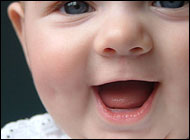
The areas stimulated by the sight of their own babies were those associated with the neurotransmitter dopamine. Specifically, the areas associated included the ventral tegmental area/substantia nigra regions, the striatum, and frontal lobe regions involved in emotion processing, cognition and motor/behavioral outputs.
"These are areas that have been activated in other experiments associated with drug addiction," said Strathearn. "It may be that seeing your own baby's smiling face is like a 'natural high' ".
The strength of the reaction depended on the baby's facial expression, he said.
"The strongest activation was with smiling faces," he said. There was less effect from pictures of their babies with sad or neutral expressions.
"We were expecting a different reaction with sad faces," he said. In fact, they found little difference in the reaction of the mothers' brains to their own babies' crying face compared to that of an unknown child.
Overall, the mothers responded much more strongly to their own infants' faces than to those of an unknown baby.
"Understanding how a mother responds uniquely to her own infant, when smiling or crying, may be the first step in understanding the neural basis of mother–infant attachment," said Strathearn.
Written and revised by
Gerald Hurowitz, M.D.
Our doctors write and review articles for accuracy and keep them up to date.
health.am provides general information, not medical advice. Always consult a qualified health professional about your own health.
Explore health topics
More in this topic
Mental Health → News
Contractors who worked in conflict zones suffer high rates of PTSD, depression
Private contractors who worked in Iraq, Afghanistan or other conflict environments over the past two years report suffering from post-traumatic stress disorder and depression more often than military personnel who…
10 December 2013
 News
Study Points to Differences in High-School Crack, Powder Cocaine Use
The use of crack and powder cocaine both varies and overlaps among high school seniors, researchers at New York University and NYU Langone Medical Center have found. Their findings, which appear in the American Journal…
6 December 2013
 News
Is left-handedness higher among those suffering from psychosis?
Researchers have long studied the connections between hand dominance and different aspects of the human brain. A new study out today in SAGE Open finds that among those with mental illnesses, left-handers are more…






