
Low-dose Glaxo bird flu vaccine seen ready in 2007
Key points
- A bird flu vaccine for humans that uses only a very low dose of active ingredient has proved effective in clinical tests and could be mass-produced in 2007, its maker GlaxoSmithKline Plc said on Wednesday.
- Glaxo Chief Executive Jean-Pierre Garnier said it was a "significant breakthrough".
- Deutsche Bank analysts said an H5N1 vaccine could have sales potential of $2 billion a year, which would add 3-5 percent to Glaxo's long-term earnings.
- Europe's biggest pharmaceuticals group said it was on track to start manufacturing by the end of 2006 and could make hundreds of millions of doses next year, assuming the product is approved by regulators.
A bird flu vaccine for humans that uses only a very low dose of active ingredient has proved effective in clinical tests and could be mass-produced in 2007, its maker GlaxoSmithKline Plc said on Wednesday.
Europe's biggest pharmaceuticals group said it was on track to start manufacturing by the end of 2006 and could make hundreds of millions of doses next year, assuming the product is approved by regulators.
It will probably cost around 4 pounds ($7.40) - the same as a conventional flu shot - and Glaxo is talking to groups like the Bill & Melinda Gates Foundation and the Global Fund to Fight AIDS, TB and Malaria about funding it in poor countries.
Glaxo believes its H5N1 vaccine will work more efficiently than rival ones in development because of the proprietary adjuvant used in its manufacture. Adjuvants are additives put into vaccines that boost the immune system and make it respond more efficiently.
A key challenge in the race to produce a vaccine for millions of people around the world - which governments are keen to stockpile - is how to make the maximum number of shots from the minimum amount of antigen, or active ingredient.
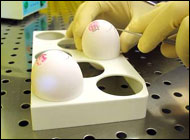
Antigen is produced in chicken eggs in a slow and laborious process.
Glaxo's vaccine contains just 3.8 micrograms of antigen, yet more than 80 percent of healthy adult volunteers who received two doses had a strong immune response.
That level of protection meets or exceeds requirements set by regulatory agencies for approving new flu vaccines, and is twice as good at half the dose as results with an experimental vaccine produced by Sanofi-Aventis.
BREAKTHROUGH
Glaxo Chief Executive Jean-Pierre Garnier said it was a "significant breakthrough".
"All being well, we expect to make regulatory filings for the vaccine in the coming months," he said.
Sanofi in May reported good responses with a vaccine using a conventional adjuvant given at two doses of 30 micrograms. But when the dose was reduced to 7.5 micrograms, only 40 percent of people were protected.
While Glaxo's vaccine offers protection against the deadly H5N1 avian flu virus now circulating, its impact on any mutated strain of virus is not certain.
However, experts say it could "prime" a person's immune system so they will get stronger effects from a later, better-matched vaccine.
Glaxo said it would now also study the ability of its vaccine to offer cross-protection to variants of the H5N1 virus.
Shares in Glaxo, which will report quarterly results at 1100 GMT on Wednesday, rose more than 1 percent following the news.
Written and revised by
Andrey Nailor, M.D.
Our doctors write and review articles for accuracy and keep them up to date.
health.am provides general information, not medical advice. Always consult a qualified health professional about your own health.