
Bacteria 'ease babies' eczema'
Key points
- Giving babies "friendly" gut bacteria during weaning can help reduce the symptoms of eczema, researchers say.
- Stool samples were taken from 21 babies who had already shown signs of atopic eczema and were at a heightened risk of developing allergies.
- The Finnish team had previously found that giving the bacteria to pregnant women, then to the baby post-natally, halved the rate of eczema in children at risk of developing allergies.
- Finnish doctors say this could be because they help change the gut's ecosystem.
Giving babies "friendly" gut bacteria during weaning can help reduce the symptoms of eczema, researchers say.
Finnish doctors say this could be because they help change the gut's ecosystem.
But UK experts have said although this is a "small brick in the wall of scientific evidence" about the effectiveness of the bacteria, this particular study was too small to be seen as reliable proof.
Eczema, or dermatitis, affects about one in five children of school age in the UK, and about one in 12 adults.
It can range from mild forms, where the skin is dry, hot and itchy, to more severe forms where the skin can become broken, raw and bleeding.
Atopic eczema is thought to be a hereditary condition, and people with it are thought to be sensitive to allergens in the environment which are harmless to others.
Atopy is an allergic reaction which has strong familial tendencies.
'Unfriendly' bacteria
Stool samples were taken from 21 babies who had already shown signs of atopic eczema and were at a heightened risk of developing allergies.
Those who were given probiotic bacteria in their milk were found to have lower levels of harmful bacteria.
Babies who were not given supplemented milk had increased levels.
Having more of the harmful bacteria was linked to higher levels of a chemical called immunoglobulin E which indicates the immune system is being stimulated.
"As doctors we have to be absolutely sure - the evidence just isn't there yet"
Professor Ashley Woodcock, Wythenshawe Hospital
These high levels are associated with diseases such as hay fever, asthma and eczema.
The researchers from the Functional Foods Forum at the University of Turku, led by Dr Pirkka Kirjavainen, say that giving babies probiotic bacteria prevents increases in levels of harmful bacteria.
They suggest this may be part of how the probiotic bacteria alleviates atopic eczema.
'Bigger studies needed'
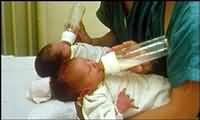
The Finnish team had previously found that giving the bacteria to pregnant women, then to the baby post-natally, halved the rate of eczema in children at risk of developing allergies.
Ashley Woodcock, professor of respiratory medicine at the North West Lung Centre at Wythenshawe Hospital, Manchester, is leading a study of the effects of friendly bacteria on 200 babies with eczema aged three to six months.
He told BBC News Online: "This is a small brick in a scientific wall of evidence.
Written and revised by
Andrey Nailor, M.D.
Our doctors write and review articles for accuracy and keep them up to date.
health.am provides general information, not medical advice. Always consult a qualified health professional about your own health.
Explore health topics
More in this topic
Lungs, Asthma & Allergies → News
Stopping the itch - new clues into how to treat eczema
More than 15% of children suffer with eczema, or atopic dermatitis, an inflammatory skin disease that in some cases can be debilitating and disfiguring. Researchers reporting in the October issue of Immunity have…
12 October 2012
NewsResearchers identify new regulator in allergic diseases
Researchers have taken a critical step in understanding how allergic reactions occur after identifying a genetic signature for regulation of a key immune hormone, interleukin (IL-13). Scientists from Cincinnati…
30 March 2012
NewsAccelerated infant growth increases risk of future asthma symptoms in children
Accelerated growth in the first three months of life, but not fetal growth, is associated with an increased risk of asthma symptoms in young children, according to a new study from The Generation R Study Group at…


