
Novel pouch could reduce mother-to-infant HIV infection
Key points
- By using medications packaged just like fast-food ketchup, HIV-positive mothers in developing countries can more easily provide protection to newborn babies born at home.
- Biomedical engineers at Duke University have developed an inexpensive and easy-to-use system that allows mothers to give their newborns a potentially life-saving dose of an anti-HIV medication shortly after birth.
- In order to be effective, the drug, known as Nevirapine, must be given to the newborn within days of birth.
- The challenge to date has been reaching distant mothers who give birth at home.
By using medications packaged just like fast-food ketchup, HIV-positive mothers in developing countries can more easily provide protection to newborn babies born at home.
Biomedical engineers at Duke University have developed an inexpensive and easy-to-use system that allows mothers to give their newborns a potentially life-saving dose of an anti-HIV medication shortly after birth. This is especially important since such drugs can only be found in clinics or hospitals, which can be days away from an expectant mother.
Timing is crucial for the newborn.
In order to be effective, the drug, known as Nevirapine, must be given to the newborn within days of birth.
The challenge to date has been reaching distant mothers who give birth at home. Since most mothers are not up to traveling that soon after delivery to get medication, the biomedical engineers developed a way of providing the medication in a simple manner and with a long shelf-life -- pouches made of foil and plastic that can hold a single dose of Nevirapine.
"In Africa, the World Health Organization (WHO) estimates that more than 90 percent of 430,000 new cases of AIDS in 2008 were attributable to mother-to-child transmission," said Carolina Gamache, program coordinator in senior researcher Robert Malkin's Developing World Healthcare Technology Laboratory at Duke's Pratt School of Engineering. "A single dose of Nevirapine right after birth has been shown to be effective in protecting the baby from the virus, but it has been difficult for many reasons to make this option available to women who give birth at home."
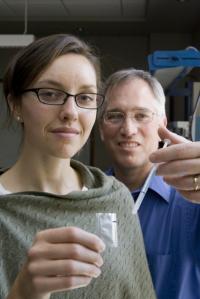
Caroline Gamache and Robert Malkin are researchers at Duke University
Gamache presented the results of the Duke research in London at the Appropriate Healthcare Technologies for Developing Countries conference, which is sponsored by WHO and the Institute of Engineering and Technology. Her paper describing the team's results was selected by judges as the conference's top research paper.
While healthcare workers in Africa have in the past tried packaging single doses by other means – syringe s and containers – they have all suffered from evaporation during storage and loss of preservatives. This is not an issue for bulk quantities of the drug, which are common in clinic and hospital pharmacies.
Also, as Gamache explained, drug manufacturers have not shown much interest in devising single-dose systems because of development costs and limited marketing potential outside the Third World. The new pouch, which was fabricated at Duke, has been shown in tests to greatly reduce evaporation while remaining potent at various temperatures – all greatly extending its life span.
"In our system, the pharmacist can fill an individual pouch for women early in their pregnancy, and they can take it home with them," Gamache said. "When the baby is born, the mother can then easily rip off the corner of the pouch and empty the drug into the newborn's mouth. Further treatments can be given to the baby at the clinic or hospital later when travel becomes easier for the mother."
Written and revised by
Andrey Nailor, M.D.
Our doctors write and review articles for accuracy and keep them up to date.
health.am provides general information, not medical advice. Always consult a qualified health professional about your own health.
Explore health topics
More in this topic
Infections, HIV & STIs → News
Researchers Look to Reduce Hep C Infections with "Staying Safe Intervention" for Injecting Drug Users
Despite a number of social/behavioral intervention and educational programs, the spread of hepatitis C (HCV) in people who inject drugs (PWIDs) remains a chronic problem. Now, researchers affiliated with New York…
23 February 2014
 News
HIV vaccines elicit immune response in infants
A new analysis of two HIV vaccine trials that involved pediatric patients shows that the investigational vaccines stimulated a critical immune response in infants born to HIV-infected mothers, researchers at Duke…
9 October 2013
NewsEarly intervention by infectious diseases specialists saves lives, reduces costs
In a first-of-its-kind study to evaluate the impact of a medical specialty on patient outcomes, researchers found that hospitalized patients with severe infections such as meningitis and Clostridium difficile (C. diff.)…


