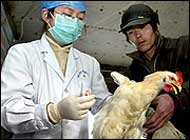
New bird flu outbreaks test Thai defences

Key points
- Thailand, among the countries hardest hit by bird flu, appeared to turn a corner this year in its fight against the virus.
- Thailand, the world's fourth-largest chicken exporter until the virus began ravaging poultry flocks in late 2003, was widely criticized for not reporting the virus when it arrived.
- The disease had not shown up in humans or chickens for nearly eight months, fuelling hopes that a widely praised government and industry campaign had finally brought the H5N1 virus to heel.
- But a new human death and fresh outbreaks in poultry in late July have exposed serious gaps in Thailand's defences and forced officials to rethink their battle plan.
Thailand, among the countries hardest hit by bird flu, appeared to turn a corner this year in its fight against the virus.
The disease had not shown up in humans or chickens for nearly eight months, fuelling hopes that a widely praised government and industry campaign had finally brought the H5N1 virus to heel.
But a new human death and fresh outbreaks in poultry in late July have exposed serious gaps in Thailand's defences and forced officials to rethink their battle plan.
"It's not entirely a surprise," said Laurence Gleeson, a bird flu expert with the U.N. Food and Agriculture Organization (FAO) who will meet Thai officials next week to review the country's surveillance and containment campaign.
"This is a disease that is difficult to eliminate completely," he said of H5N1, which has killed 134 people worldwide, including a 15th Thai on July 24.
An outbreak in the northern province of Pichit, where the 17-year-old youth died, revealed shortcomings officials are now scrambling to fix.
Despite the threat of fines and public awareness campaigns, the youth's family did not report their sick chickens, fearing authorities would cull the rest of the flock.
Critics say the compensation paid to farmers, worth 75 percent of the market price, should be increased.
Instead, the government says fines for failing to report bird deaths, rarely imposed in the past year, will now be enforced strictly in all 76 provinces.
Farmers who do not report bird deaths within 12 hours will face a 4,000 baht ($105) fine or two months' jail, Agriculture Minister Sudarat Keyuraphan said.
The teenager's death also triggered a review of how doctors administer Tamiflu, the most commonly used anti-bird flu drug.
Doctors believed the youth had dengue fever and did not give Tamiflu despite his known close contact with poultry.
New guidelines will now require doctors to administer Tamiflu, most effective within 48 hours after symptoms appear, in suspected cases rather than wait for laboratory results.
COVER UP?
Thailand, the world's fourth-largest chicken exporter until the virus began ravaging poultry flocks in late 2003, was widely criticized for not reporting the virus when it arrived.
But since then, the government has won international praise for its surveillance and control efforts, involving 13 government ministries and two million volunteers who scoured villages and live markets for sick poultry.
But no system is foolproof and constant fine-tuning is needed against a virus still evolving, animal health experts say.
Critics say Thailand's success has bred complacency and led some local officials to try again to hide outbreaks.
Written and revised by
David Cohen, M.D.
Our doctors write and review articles for accuracy and keep them up to date.
health.am provides general information, not medical advice. Always consult a qualified health professional about your own health.
Explore health topics
More in this topic
Infections, HIV & STIs → News
Hanoi says first bird flu vaccine tests successful
Initial tests of a bird flu vaccine on monkeys in Vietnam have been successful, medical officials said on Friday, adding than tests in humans could be only months away. Vietnam is the country hardest hit by an epidemic…
5 March 2005
NewsGenetic testing needed to follow TB outbreaks
Simply tracing one exposed person to the next is not an accurate way to follow the spread of tuberculosis, Norwegian researchers report. Instead, formal genetic testing, or "genotyping," is needed. Reporting in the…
12 February 2005
NewsVietnam testing two more suspected bird flu cases
Vietnam is testing samples from two more suspected bird flu cases, one of whom has died, as the country grapples to control a strain of the illness that has killed dozens and ravaged the region's poultry industry. An…