Milestones in vaccine history
Key points
- It was almost 100 years after Jenner's seminal work that vaccination moved beyond smallpox.
- Unfortunately, after the DPT booster vaccine became widely used, serious adverse reactions including convulsions, brain damage, and even death were noted in a tiny percentage of children who were vaccinated.
- Development of viral vaccines and bacteria-based vaccines flourished: the development of vaccines against more than 20 diseases has affected disease morbidity and mortality.
- Toxins produced by B. pertussis can cause high fever, convulsions, brain damage, and death.
It was almost 100 years after Jenner's seminal work that vaccination moved beyond smallpox. The French chemist, Louis Pasteur, developed what he called a rabies vaccine in 1885, but technically what he produced was a rabies antitoxin that functioned as a postinfection antidote.[10] By the 20th century, advances in the science of virology bacteriology and immunology led to a better understanding of how the human body defends itself against invading microorganisms.
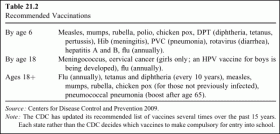
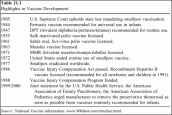
Development of viral vaccines and bacteria-based vaccines flourished: the development of vaccines against more than 20 diseases has affected disease morbidity and mortality. Since 1980, more than 15 new or improved vaccines have been approved as a result of advances in molecular biology and genetics, which led to new and improved subunit vaccines that promise to offer increased safety and efficacy. (See table 21.1 for a listing of some of the highlights in history of vaccine development and table 21.2 for a listing of currently recommended childhood vaccinations.)
PERTUSSIS AND DIPHTHERIA
Although the causative agent of pertussis (whooping cough) was isolated in 1907, it was not until the late 1920s that the first whole-killed pertussis vaccine was introduced.[11] Pertussis, particularly serious among infants, is a contagious respiratory disease caused by the B. pertussis bacterium and spread by coughing or sneezing. Toxins produced by B. pertussis can cause high fever, convulsions, brain damage, and death.
Diphtheria, also caused by a bacterium, is a contagious and potentially lifethreatening infection that usually attacks the throat and nose. In more serious cases, it can attack the nerves and heart. Although he survived smallpox, George Washington may have died of diphtheria. In the mid-1930s, a vaccine against pertussis and diphtheria was developed and was later modified in 1947 to include tetanus (the diphtheria, pertussis, and tetanus [DPT] vaccine). In the 21st century, the DPT shot is among the first that an infant receives after birth. A child needs five DPT shots,
given at specified intervals, to ensure complete protection.
Highlights in Vaccine Development
Unfortunately, after the DPT booster vaccine became widely used, serious adverse reactions including convulsions, brain damage, and even death were noted in a tiny percentage of children who were vaccinated. In particular, the pertussis component of the DPT vaccine was identified as causing problems in some children. As a result, children with a history of convulsions or neurological disease were strongly advised not to be vaccinated.[12-14] Although serious acute neurologic illness was a rare event, the Institute of Medicine (IOM) was mandated by Congress to study the issue. In 1991, the IOM issued its report and concluded that the evidence was insufficient to indicate a causal relation between DPT and neurologic damage.[15]
Written and revised by
Andrey Nailor, M.D.
Our doctors write and review articles for accuracy and keep them up to date.
health.am provides general information, not medical advice. Always consult a qualified health professional about your own health.
Explore health topics
More in this topic
Infections, HIV & STIs → News
Scientists see AIDS vaccine within reach after decades
At an ill-fated press conference in 1984, U.S. Health and Human Services Secretary Margaret Heckler boldly predicted an effective AIDS vaccine would be available within just two years. But a string of failed attempts -…
17 July 2012
 News
HIV vaccine trial approved by FDA
A vaccine that may prevent HIV has been given the green light by the U.S. Food and Drug Administration to begin clinical trials in humans, according to Canadian researchers. The announcement was made on the campus of…
8 April 2012
 News
HIV/AIDS vaccine shows long-term protection against multiple exposures in nonhuman primates
An Atlanta research collaboration may be one step closer to finding a vaccine that will provide long-lasting protection against repeated exposures to human immunodeficiency virus (HIV). Scientists at Emory University…
9 March 2012