
H1N1 Flu: Are Parents Underestimating Risk to Kids?
Key points
- With schools back in session, H1N1 flu has become more active across the United States—especially among children.
- Mott Children’s Hospital National Poll on Children’s Health finds only 40 percent of parents indicate they will get their children vaccinated against H1N1 flu—while 54 percent of parents indicate they will get their children vaccinated against seasonal flu.
- “This information about parents’ plans to vaccinate their kids against H1N1 flu suggests that parents are much less concerned about H1N1 flu than seasonal flu for their kids.
- The poll also shows vaccination plans for H1N1 flu differs by racial/ethnic groups.
With schools back in session, H1N1 flu has become more active across the United States—especially among children. A new vaccine against H1N1 flu—strongly recommended for kids—has been tested and is expected to be available in October. But will parents get their children vaccinated?
The latest C.S. Mott Children’s Hospital National Poll on Children’s Health finds only 40 percent of parents indicate they will get their children vaccinated against H1N1 flu—while 54 percent of parents indicate they will get their children vaccinated against seasonal flu. Among parents who do not plan to get their children vaccinated against H1N1 flu, 46 percent indicate they are not worried about their children getting H1N1 flu, while 20 percent believe H1N1 flu is not serious.
“This information about parents’ plans to vaccinate their kids against H1N1 flu suggests that parents are much less concerned about H1N1 flu than seasonal flu for their kids. That perception may not match the actual risks,” says Matthew Davis, M.D., director of the poll and associate professor of pediatrics and internal medicine in the Child Health Evaluation and Research Unit at the University of Michigan Medical School.
The poll also shows vaccination plans for H1N1 flu differs by racial/ethnic groups. More than half of Hispanic parents plan to have their children vaccinated against H1N1 flu, compared to only 38 percent of white parents and 30 percent of black parents.
Vaccination plans of Hispanic parents may reflect a higher perceived risk in the Hispanic community, given the well publicized outbreak of H1N1 flu in Mexico in early 2009, Davis says.
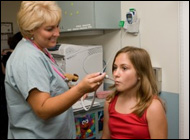
In describing their perceived risk of H1N1 flu for children, one-third of parents indicate they believe H1N1 flu will be worse than seasonal flu. Nearly half of parents believe H1N1 and seasonal flu will be about the same for children, according to the poll.
These perceptions contrast information from the CDC suggesting that—unlike what is typically seen with seasonal flu—rates of illness and hospitalizations related to H1N1 flu are higher for children than for other age groups.
“It can be difficult to follow all the new information about a fast moving target like H1N1 flu,” says Davis, who is also associate professor of public policy at the U-M Gerald R. Ford School of Public Policy. “Health care professionals and public health officials need to help parents and the community at-large understand that children are one of the groups at greatest risk for getting H1N1, and for getting very sick from the disease as well.”
Among parents who do not plan to get their children vaccinated against H1N1 flu, or who are unsure, about half are worried about possible side effects of the vaccine. Among parents who do plan to get their children vaccinated against H1N1 flu, about 4 in 5 believe that H1N1 is a serious disease and worry about their children getting H1N1 illness. Parents who think H1N1 flu will be worse for children than seasonal flu were much more likely to plan to have their children vaccinated against H1N1 flu.
Written and revised by
David Cohen, M.D.
Our doctors write and review articles for accuracy and keep them up to date.
health.am provides general information, not medical advice. Always consult a qualified health professional about your own health.
Explore health topics
More in this topic
Infections, HIV & STIs → News
High HIV knowledge and risky sexual behavior not associated with HIV testing in young adolescents
Having high knowledge about HIV and engaging in risky sexual activity do not make high-school-aged teens more likely to get tested for HIV. Those are the findings of a new study by researchers at Montefiore Medical…
22 November 2013
 News
Even healthy kids can die from flu complications
A new report underscores what health professionals know but parents may not: The flu can be fatal to children, even healthy kids who don't have other medical conditions. Researchers with the Centers for Disease Control…
28 October 2013
 News
Obesity may increase the risk of Clostridium difficile infection
Researchers from Boston Medical Center (BMC) and Boston University School of Medicine (BUSM) have identified obesity as a possible risk factor for clostridium difficile infection (CDI). These findings, which appear…


