
What Causes a Heart Attack?
Key points
- Most heart attacks are caused by a blood clot that blocks one of the coronary arteries (the blood vessels that bring blood and oxygen to the heart muscle).
- coronary artery disease (CAD) is the most common underlying cause of a Heart Attack.
- A less common cause of heart attacks is a severe spasm (tightening) of the coronary artery that cuts off blood flow to the heart.
- About one-quarter of all heart attacks occur without producing any identifiable symptoms.
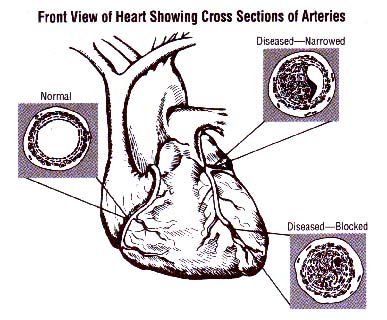
Most heart attacks are caused by a blood clot that blocks one of the coronary arteries (the blood vessels that bring blood and oxygen to the heart muscle). When blood cannot reach part of your heart, that area starves for oxygen. If the blockage continues long enough, cells in the affected area die.
coronary artery disease (CAD) is the most common underlying cause of a Heart Attack. CAD is the hardening and narrowing of the coronary arteries by the buildup of plaque in the inside walls (Atherosclerosis). Over time, plaque buildup in the coronary arteries can:
- Narrow the arteries so that less blood flows to the heart muscle
- Completely block the arteries and the flow of blood
- Cause blood clots to form and block the arteries.
A less common cause of heart attacks is a severe spasm (tightening) of the coronary artery that cuts off blood flow to the heart. These spasms can occur in persons with or without CAD. Artery spasm can sometimes be caused by:
- Taking certain drugs, such as cocaine
- Emotional stress
- Exposure to cold
- Cigarette smoking.
The following also may cause heart attack:
- Complications from bypass surgery or Cardiac catheterization
- Congenital heart conditions (i.e., conditions present at birth)
- Coronary embolization (blood clot from elsewhere in the body that breaks away and travels to the heart)
- Drug abuse (e.g., cocaine use may impede blood flow in the heart)
- Inflammatory artery disease (indicated by the presence of markers in the blood such as interleukin-18 [IL-18] or C-reactive protein [CRP])
- Trauma (cut, severe blow, or stab wound to the heart)
About one-quarter of all heart attacks occur without producing any identifiable symptoms. These so-called "silent" heart attacks may only be discovered incidentally by examination of an electrocardiogram (EKG) or by other heart test.
Written and revised by
David Cohen, M.D.
Our doctors write and review articles for accuracy and keep them up to date.
health.am provides general information, not medical advice. Always consult a qualified health professional about your own health.
Explore health topics
More in this topic
Heart & Blood Vessels → News
Novel gene-finding approach yields a new gene linked to key heart attack risk factor
Scientists have discovered a previously unrecognized gene variation that makes humans have healthier blood lipid levels and reduced risk of heart attacks - a finding that opens the door to using this knowledge in…
16 March 2014
 News
Study shows nearly fivefold increased risk for heart attack after angry outburst
Call it what you will - getting red in the face, hot under the collar, losing your cool, blowing your top – we all experience anger. And while we know that anger is a normal, sometimes even beneficial emotion, we're…
4 March 2014
 News
Death of partner associated with increased risk of heart attack, stroke
The risk of heart attack or stroke is increased in the 30 days after a partner's death. Bereavement is recognized as a risk factor for death and is associated with cardiovascular events. The authors compared the rate of…



