Varicose Veins
Key points
- Venous insufficiency is a very common condition resulting from decreased blood flow from the leg veins up to the heart, with pooling of blood in the veins.
- Chronic venous disease of the legs is one of the most common conditions affecting people of all races.
- Symptoms caused by venous insufficiency and varicose veins include aching pain, easily tired legs, and leg heaviness, all of which worsen as the day goes on.
- An interventional radiologist, a doctor specially trained in performing minimally invasive treatments using imaging guidance, will use duplex ultrasound to assess the venous anatomy, vein valve function, and venous blood flow changes, which can assist in diagnosing venous insufficiency.
Non-Surgical Outpatient Procedure Treats Varicose Veins
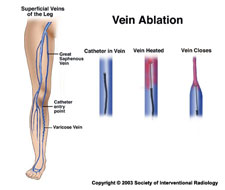
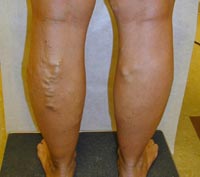
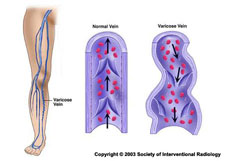
Venous insufficiency is a very common condition resulting from decreased blood flow from the leg veins up to the heart, with pooling of blood in the veins. Normally, one-way valves in the veins keep blood flowing toward the heart, against the force of gravity. When the valves become weak and don't close properly, they allow blood to flow backward, a condition called reflux. Veins that have lost their valve effectiveness, become elongated, rope-like, bulged, and thickened. These enlarged, swollen vessels are known as varicose veins and are a direct result of increased pressure from reflux. A common cause of varicose veins in the legs is reflux in a thigh vein called the great saphenous, which leads to pooling in the visible varicose vein below.
How Common Is This Condition?
Chronic venous disease of the legs is one of the most common conditions affecting people of all races.
- Approximately half of the U.S. population has venous disease-50 to 55% of women and 40 to 45% of men. Of these, 20 to 25% of the women and 10 to 15% of men will have visible varicose veins.
- Varicose veins affect 1 out of 2 people age 50 and older, and 15 to 25% of all adults.
Risk Factors
- Age
- Family history
- Female gender
- Pregnancy, especially multiple pregnancies, is one of the most common factors accelerating the worsening of varicose veins.
Symptoms
Symptoms caused by venous insufficiency and varicose veins include aching pain, easily tired legs, and leg heaviness, all of which worsen as the day goes on. Many people find they need to sit down in the afternoon and elevate their legs to relieve these symptoms. In more severe cases, venous insufficiency and reflux can cause darkening of the skin and wounds that may be very difficult to treat. One percent of adults over age 60 have chronic wounds known as ulcers.
People who have venous insufficiency can have symptoms even without visible varicose veins. The symptoms are caused by pressure on nerves by dilated veins.
Varicose Vein Diagnosis
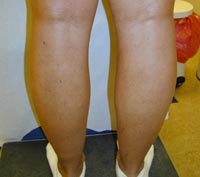
An interventional radiologist, a doctor specially trained in performing minimally invasive treatments using imaging guidance, will use duplex ultrasound to assess the venous anatomy, vein valve function, and venous blood flow changes, which can assist in diagnosing venous insufficiency. The doctor will map the great saphenous vein and examine the deep and superficial venous systems to determine if the veins are open and to pinpoint any reflux. This will help determine if the patient is a candidate for a minimally invasive treatment, known as vein ablation.
Written and revised by
David Cohen, M.D.
Our doctors write and review articles for accuracy and keep them up to date.
health.am provides general information, not medical advice. Always consult a qualified health professional about your own health.
Explore health topics
More in this topic
Heart & Blood Vessels → News
Emerging vascular risk factors in women: Any differences from men?
The incidence and severity of both traditional and emerging cardiovascular disease (CVD) risk factors as well as the response to treatment may differ between genders. In this narrative review, several emerging CVD risk…
6 February 2016
 News
Study shows minorities had lower risk of coronary heart disease than whites
In a study of more than 1.3 million Kaiser Permanente members in Northern California that stretched over 10 years, researchers found that blacks, Latinos and Asians generally had lower risk of coronary heart disease…
29 January 2016
 News
Finding the right antithrombotic (anti-clotting) drug for you
A new blood clotting analysis system designed in Japan makes it easier to determine the effects of taking one or more antithrombotic (anti-clotting) drugs. Myocardial infarction, arrhythmia (atrial fibrillation),…