Varicocele
Key points
- Non-surgical Treatment for Male Infertility A varicocele is a varicose vein of the testicle and scrotum that may cause pain, testicular atrophy (shrinkage) or fertility problems.
- Symptoms Pain - aching pain when an individual has been standing or sitting for long periods of time and pressure builds up on the affected veins.
- Diagnosis is fairly simple through either physical or diagnostic examination.
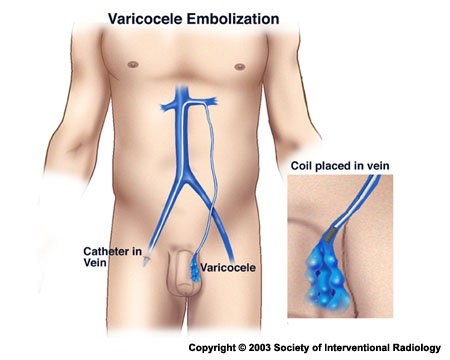
- Catheter-directed Embolization Catheter directed embolization is a non-surgical, outpatient treatment performed by an interventional radiologist using imaging to guide catheters or other instruments inside the body.
Varicocele Overview
Non-surgical Treatment for Male Infertility
A varicocele is a varicose vein of the testicle and scrotum that may cause pain, testicular atrophy (shrinkage) or fertility problems. Veins contain one-way valves that work to allow blood to flow from the testicles and scrotum back to the heart. When these valves fail, the blood pools and enlarges the veins around the testicle in the scrotum to cause a varicocele. Open surgical ligation, performed by a urologist, is the most common treatment for symptomatic varicoceles. Varicocele embolization, a non-surgical treatment performed by an interventional radiologist, is a highly effective, widely available technique to treat symptomatic varicoceles that is greatly underutilized in this country.
Prevalence
- Approximately 10 percent of all men have varicoceles - among infertile couples, the incidence of varicoceles increases to 30 percent
- Highest occurrence in men aged 15-35
- As many as 70-80,000 men in America may undergo surgical correction of varicocele annually
Symptoms
Pain - aching pain when an individual has been standing or sitting for long periods of time and pressure builds up on the affected veins. Typically, painful varicoceles are prominent in size.
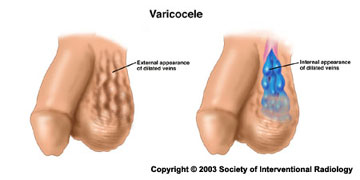
Fertility Problems - There is an association between varicoceles and infertility. The incidence of varicocele increases to 30 percent in infertile couples. Decreased sperm count, decreased motility of sperm, and an increase in the number of deformed sperm are related to varicoceles. Some experts believe that blocked and enlarged veins around the testes, called varicoceles, cause infertility by raising the temperature in the scrotum and decreasing sperm production.
Testicular Atrophy - Shrinking of the testicles is another sign of varicoceles. Often, once the testicle is repaired it will return to normal size.
Varicocele Diagnosis
Diagnosis is fairly simple through either physical or diagnostic examination.
- Typical on left side of scrotum
- Physical exam - visible - scrotum looks like a "bag of worms"
- Testicle can shrink in size / atrophy
- When varicoceles are not clearly present, the abnormal blood flow can often be detected with a noninvasive imaging exam called color flow ultrasound or through a venogram-an X-ray in which a special dye is injected into the veins to "highlight" blood vessel abnormalities
Written and revised by
Gerald Hurowitz, M.D.
Our doctors write and review articles for accuracy and keep them up to date.
health.am provides general information, not medical advice. Always consult a qualified health professional about your own health.
Explore health topics
More in this topic
Heart & Blood Vessels → News
Patients with abnormally fast heart rhythms to benefit from modification of treatment
A simple, safe and cost-free modification to a physical technique used to treat patients in the emergency department with an abnormally fast heart rhythm could improve its effectiveness by more than a quarter, according…
26 August 2015
 News
Supercomputers listen to the heart
New supercomputer models have come closer than ever to capturing the behavior of normal human heart valves and their replacements, according to recent studies by groups including scientists at the Institute for…
21 August 2015
 News
Just 1 in 10 are referred for cardiac rehab after treatment for heart failure
Only 1 in 10 heart failure patients is referred to a cardiac rehabilitation program after being hospitalized, despite strong evidence that such exercise programs improve quality of life and reduce the likelihood of…