
Patients to be given heart attacks
Key points
- A British surgeon is looking to give three patients heart attacks - live on a satellite link up.
- Conference delegates will be able to watch and up to 1,000 will be able to ask Dr Stables questions during the procedure and offer him advice via satellite linkup.
- The procedure helps reduce the effects of hypertrophic obstructive cardiomyopathy, which is an unusual thickness of the muscular wall of the heart.
- The operation, to cure a rare condition, will be broadcast live to more than 3,000 delegates at a conference in Berlin.
A British surgeon is looking to give three patients heart attacks - live on a satellite link up.
The operation, to cure a rare condition, will be broadcast live to more than 3,000 delegates at a conference in Berlin.
Dr Rod Stables, a cardiologist at the Broadgreen Cardiothoracic Centre in Liverpool, will inject alcohol directly into the hearts of three patients, giving them cardiac arrests in a bid to cure a rare condition.
The three consecutive operations, which will be carried out at the Liverpool centre, will be broadcast live to the European Society of Cardiology conference attended by some of the world's top heart experts.
The performance of Dr Stables' team will be judged by an international panel of surgeons led by Dr Ulrich Sigwart, who pioneered the technique six years ago.
Questions
Conference delegates will be able to watch and up to 1,000 will be able to ask Dr Stables questions during the procedure and offer him advice via satellite linkup.
They will view his work on three giant screens three metres high and six metres wide.
Dr Stables said he will not feel the pressure of so many people looking over his shoulder during the operations, which will be carried out in September.
He said: "It stands to reason that it must involve slightly more pressure, but if you were a person of nervous disposition, you would not be doing this procedure.
"It has great value as an educational tool. Conference delegates will be able to ask questions as I perform the procedure and I will provide an explanation of what I am doing at every stage.
"It is very intricate and involves a very precise manipulation of the heart from outside the body"
Dr Rod Stables
"It is very intricate and involves a very precise manipulation of the heart from outside the body."
The three patients have not yet been selected for the operations but it is believed two will be from the North West and one from Scotland.
The surgery
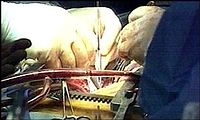
The procedure helps reduce the effects of hypertrophic obstructive cardiomyopathy, which is an unusual thickness of the muscular wall of the heart.
When the heart beats the muscle wall contracts and bulges into the pathway of blood trying to leave the heart, causing an obstruction.
"Given that it is by design a destructive procedure, it is remarkably well tolerated, and generally very safe"
Dr Rod Stables
Dr Stables will insert a temporary pacemaker into the right side of the patients' hearts and place a tube into a blood vessel leading to the affected area.
Written and revised by
Gerald Hurowitz, M.D.
Our doctors write and review articles for accuracy and keep them up to date.
health.am provides general information, not medical advice. Always consult a qualified health professional about your own health.
Explore health topics
More in this topic
Heart & Blood Vessels → News
Younger men receive faster care for heart attacks, angina compared with women of same age
A new study indicates that in younger adults experiencing heart attacks and angina, men are more likely to receive faster care compared with women. The study, published in CMAJ (Canadian Medical Association Journal)…
18 March 2014
 News
Deaths higher for heart attack patients at night and weekends
Mortality is higher, and emergency treatment takes longer, for heart attack patients who arrive at hospital during the night or at weekends compared with regular hours, finds a study published on bmj.com today. The…
22 January 2014
 News
Wayne State discovers potential treatment for better heart health in hemodialysis patients
Researchers at Wayne State University have discovered a potential way to improve the lipid profiles in patients undergoing hemodialysis that may prevent cardiovascular disease common in these patients. Patients…



